
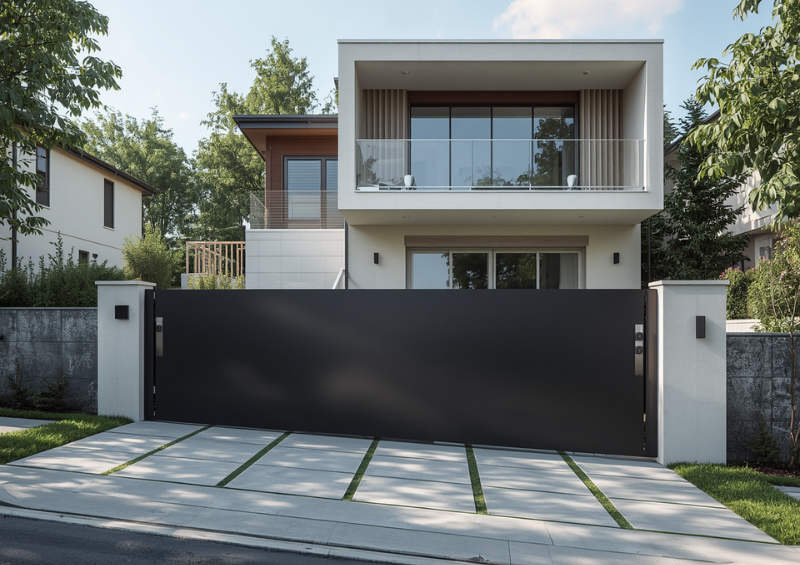
Installing an automated gate on a flat driveway is relatively straightforward. However, when dealing with sloped driveways or uneven terrain, the process becomes significantly more complex. Many property owners encounter issues such as gates failing to open properly, motors becoming overloaded, or safety risks caused by poor alignment. These challenges are especially common in residential properties with steep inclines. Choosing the wrong type of gate or automation system can lead to long-term performance issues and costly adjustments.
This guide explores the best gate automation options for sloped driveways and challenging sites. It focuses on practical solutions, system design considerations, and choosing the right setup for your specific conditions.
Table of Contents
ToggleWhy Sloped Driveways Are Challenging for Gate Automation
Most gate systems are engineered with flat ground in mind. On a slope, everything changes—mechanics, load distribution, and movement geometry. When a driveway is sloped, the gate’s geometry changes as it opens and closes. This creates several mechanical and operational challenges.
One of the most common issues is ground clearance. A standard swing gate may scrape against the ground when installed on an incline. This not only affects usability but can also damage the gate and motor over time.
Another challenge is motor strain. When a gate operates on a slope, the motor must work harder to move the gate against gravity. This can shorten the system’s lifespan and increase the risk of failure.
Safety is also a concern. Improperly installed gates on sloped surfaces may close unevenly or apply excessive force, creating potential hazards for vehicles and pedestrians.
The result is simple: if you install a standard system without adapting it to the slope, it will fail faster than expected.
That’s why gate automation for sloped driveway projects must begin with site analysis—not product selection.
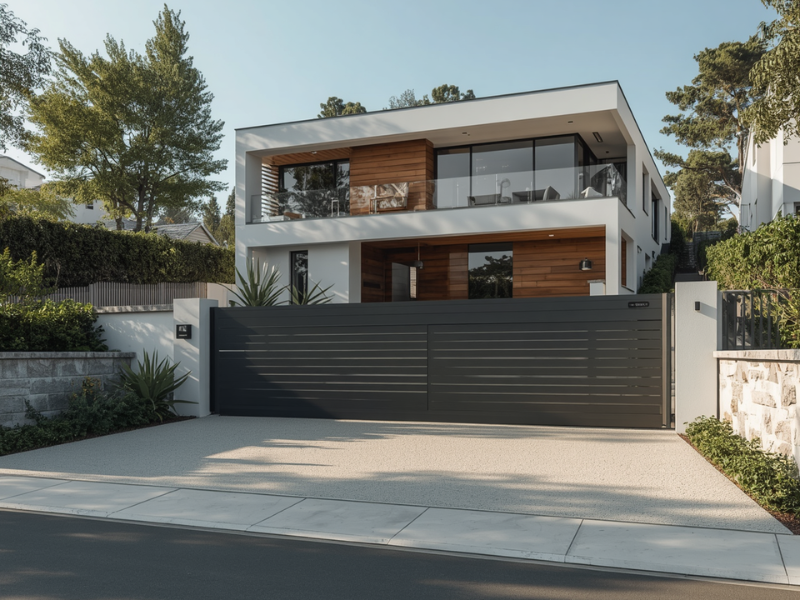
Understanding the Type and Direction of Your Slope
Before choosing a system, you need to understand what kind of slope you’re dealing with. Not all slopes create the same challenges.
An upward slope (rising toward the property) forces the motor to work harder when operating. A downward slope does the opposite—it accelerates the gate during closing, which can strain braking systems and reduce control.
Cross slopes (side-to-side uneven ground) create alignment issues that affect both swing and sliding gates.
Each scenario requires a different solution. Without identifying your slope type, even a high-end system may perform poorly.
Moreover, gravity is one of the most underestimated factors in gate automation for sloped driveway systems.
On an incline:
- The motor must overcome additional resistance when moving uphill
- The gate gains momentum when moving downhill
- Stopping distance increases
- Mechanical stress is amplified
This means a gate that performs perfectly on flat ground may struggle or fail on a slope. The solution is simple but often ignored: always overspec the motor for sloped conditions.
Key Factors to Consider Before Installation
When planning gate automation for a sloped driveway, several factors must be evaluated to ensure a successful installation.
The slope’s degree is one of the most important considerations. Steeper slopes require more specialised solutions, while moderate inclines may allow for greater flexibility in gate design.
Space availability also plays a critical role. Sliding gates require sufficient lateral space to move, while swing gates need clearance to open. Understanding these spatial constraints helps determine the most suitable option.
Gate weight and size must also be taken into account. Heavier gates require more powerful motors to operate the system.
Best Types of Gate Automation for Sloped Driveways
Choosing the right type of gate is the first step in solving slope-related challenges. Not all gate designs are suitable for uneven terrain, and selecting the wrong type can lead to ongoing issues.
Why Sliding Gates Are the Preferred Solution for Sloped Driveways
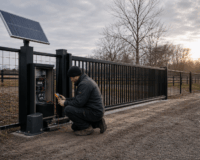
For most sloped driveway gate automation scenarios, sliding gates are the most reliable choice. Sliding gates move horizontally along a track; they are not affected by vertical changes in the ground. This makes them ideal for steep slopes or areas with limited clearance.
Unlike swing gates, sliding gates move horizontally along a straight path. This eliminates the biggest issue with slopes: ground clearance.
Key advantages include:
- Consistent operation regardless of incline
- No arc movement that conflicts with the ground
- Reduced mechanical stress compared to swing systems
- Better suitability for steep or uneven terrain
In challenging environments, sliding systems are not just an option—they are often the optimal solution.
Key considerations include:
- A perfectly level track (for track systems)
- Adequate side clearance equal to the gate width
- Strong foundations to prevent shifting
- Proper alignment to avoid uneven wear
Small errors during installation can lead to long-term problems, including motor strain and premature component failure.
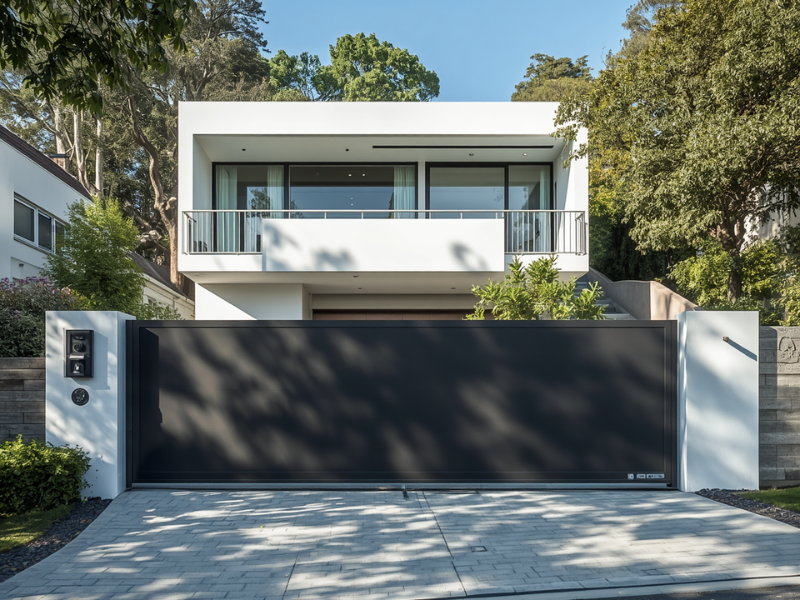
Track vs Cantilever Sliding Gates on Slopes
Once you choose a sliding system, the next decision is whether to use a track-based or cantilever design.
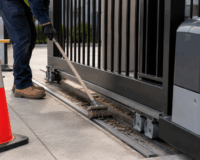
Track sliding gates run along a ground rail. They require precise levelling and are sensitive to debris, water, and ground movement.
Cantilever gates, on the other hand, are suspended above the ground and supported by rollers. They are often better suited for difficult sites because:
- They avoid ground contact issues
- They perform better in uneven or shifting terrain
- They reduce maintenance caused by debris and water
However, cantilever systems require more space and stronger structural support, which must be factored into your planning.
When a Swing Gate on a Slope Can Work
Despite their limitations, swing gate on slope installations are still possible under the right conditions.
They are most suitable when:
- The slope is mild
- Adequate ground clearance is available
- The gate is designed specifically for the slope
Custom raked gates can maintain consistent clearance and prevent scraping. However, they require precise fabrication and installation.
Swing gates can still be used on sloped driveways, but they require careful design. In some cases, the gate can be installed to swing inward toward the higher ground, allowing it to open without obstruction. However, this depends on the available space and the slope’s degree.
Other Choices for Sloped Driveways
Articulated arm motors are another option for swing gates on uneven surfaces. These systems provide greater flexibility in movement, making them more suitable for installations where standard linear motors may struggle.
Underground motors can also improve aesthetics and performance, but they require precise installation and are generally better suited to moderate slopes than to extreme inclines.
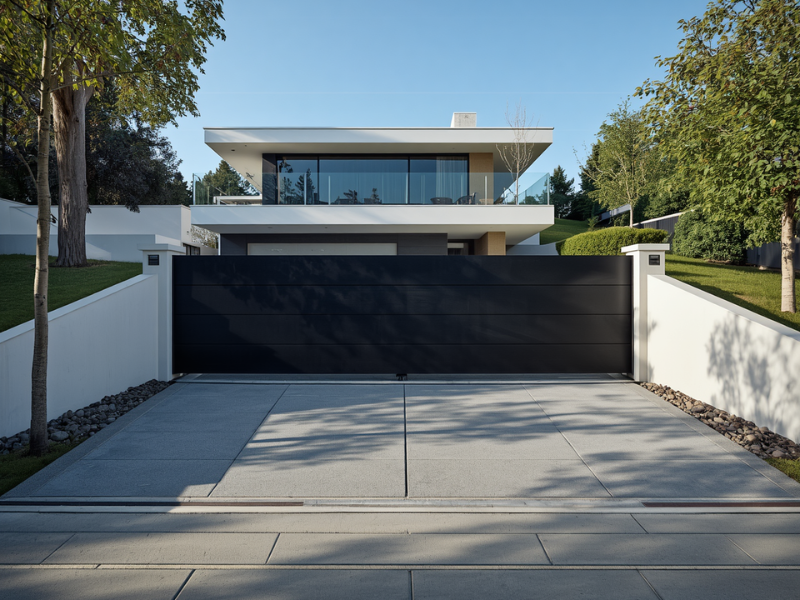
Which Gate Automation System Should You Choose?
The right system depends on the specific characteristics of your driveway and site conditions. There is no one-size-fits-all solution, and each option has its advantages depending on the scenario.
For steep or highly uneven driveways, sliding gates are typically the best choice. They provide consistent performance, require less adjustment, and place less strain on the motor. They are a reliable long-term solution for challenging environments.
For properties where a swing gate is preferred due to design or space constraints, choosing the right motor is critical. Articulated arm motors can accommodate moderate slopes, but they must be carefully specified to ensure proper operation.
In situations where aesthetics are a priority, underground motors can offer a discreet solution. However, they require professional installation and may not be suitable for all slope conditions.
Motor Selection for Challenging Sites
Choosing the right motor is critical for long-term reliability.
For sloped installations, look for:
- Higher torque capacity than standard requirements
- Soft start and stop functionality
- Adjustable speed and force settings
- Built-in safety and obstacle detection
Beninca systems are often selected for their durability and ability to handle heavy loads, while Nice offers advanced control features that improve smoothness and efficiency.
The key is not just power—it’s controlled power.
Safety Considerations for Sloped Installations
Safety becomes even more critical on slopes.
Risks include:
- Gates accelerating downhill
- Increased closing force
- Uneven stopping behavior
To mitigate these risks, your system should include:
- Safety sensors and photocells
- Automatic stop and reverse functions
- Controlled braking systems
- Adjustable force settings
A safe system is not just compliant—it protects both users and equipment.
Common Mistakes in Sloped Gate Projects
Several mistakes appear repeatedly in these installations.
One of the most common mistakes is choosing a gate type based solely on appearance rather than functionality. While certain designs may look appealing, they may not perform well on sloped driveways.
Another mistake is underestimating the importance of motor selection. Using a motor that is not designed for slope conditions can lead to system failure.
Improper installation is also a major issue. Even the best equipment can perform poorly if it is not installed correctly. Ensuring proper alignment, clearance, and support is essential for long-term reliability.
Failing to plan for future maintenance is another common oversight. Systems installed on slopes may require more frequent adjustments, and accessibility should be considered during the design phase.
Integrate Your Gate With Smart Access Systems
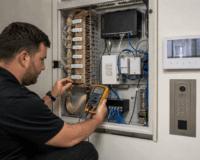
Modern gate automation systems can be integrated with broader smart home or security systems. This allows users to control gate access remotely, monitor activity, and automate entry based on specific conditions.
Integration with access control systems enables features such as keypad entry, mobile app control, and remote access management. This is particularly useful for properties with multiple users or frequent visitors.
Video intercom systems can also be combined with gate automation, allowing users to verify visitors before granting access. This adds an additional layer of security and convenience.
By integrating gate automation with other systems, property owners can create a more connected and efficient entry solution.
Both Beninca and Nice Motors offer reliable solutions for challenging sites.
Beninca Motors are often chosen for:
- Heavy-duty applications
- High-load performance
- Long-term durability
Nice Motors are preferred for:
- Smart automation features
- Smooth and quiet operation
- Advanced control systems
The right choice depends on your priorities and site conditions.
Final Thoughts: Designing for the Site, Not Against It
Sloped driveways are not a limitation—they’re a design challenge that requires the right solution.
By focusing on proper sloped driveway gate automation, choosing the right system type, and selecting a motor that can handle real-world conditions, you can create a system that performs reliably for years.
In most cases, sliding gates provide the best balance of performance and durability. But regardless of the system you choose, success comes down to one principle:
Design for the slope—not against it.

1 Comment
[…] Read more: Best Gate Automation Options For Sloped Driveways And Challenging Sites […]