Choosing the correct magnetic lock holding force is one of the most important decisions when specifying maglocks. Many installers assume that selecting the highest holding force delivers better security. In reality, the best choice depends on the application, gate construction, environmental conditions, and overall access control design. An oversized magnetic lock for the application may increase costs and offer little practical benefit. Conversely, an undersized lock may fail to meet operational and security requirements.
This guide explains the differences between 300kg and 600kg magnetic locks, helping installers evaluate key considerations when selecting the most appropriate magnetic lock holding force for a project.
Understanding Magnetic Lock Holding Force Ratings
Before comparing lock sizes, it is important to understand what magnetic lock holding force actually represents and how manufacturers determine these ratings.
What Does Magnetic Lock Holding Force Mean?
Magnetic lock holding force refers to the maximum static force required to separate the armature plate from the electromagnet when the lock is energised.
Manufacturers typically test magnetic locks under controlled laboratory conditions using perfectly aligned mounting surfaces and stable power supplies. These tests generate the published holding-force ratings used in product specifications.
However, laboratory results do not always reflect real-world installations. Gate flex, environmental conditions, mounting quality, and power fluctuations can all influence the performance of a maglock. As a result, installers should view holding-force ratings as a benchmark rather than a guarantee of field performance.
Static pull-force ratings are useful for product comparison, but overall security depends on many factors beyond the rated magnetic lock holding force alone.
How Holding Force Is Measured
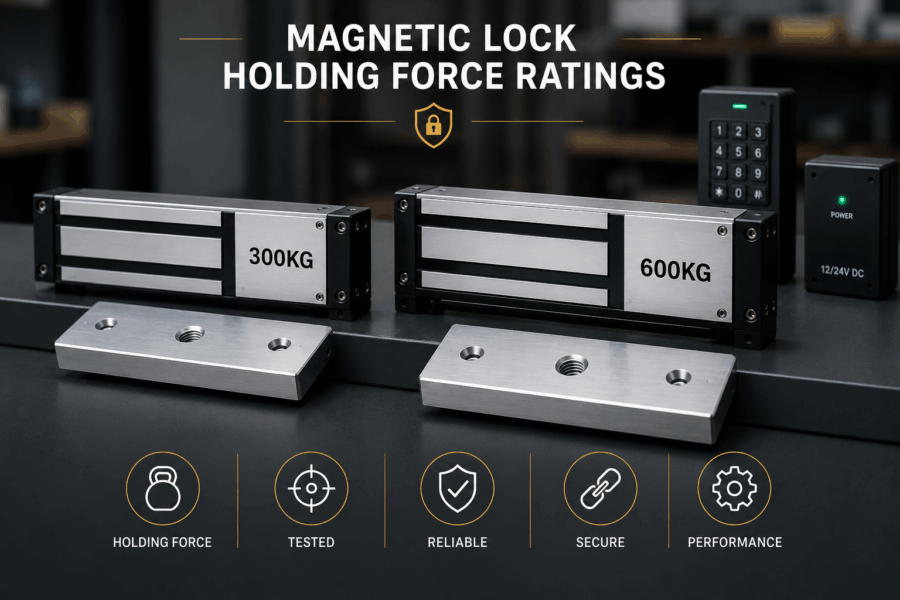
Manufacturers commonly publish holding-force ratings using both kilograms and Newtons:
- 300kg Maglock – approximately 2,940N holding force
- 600kg Maglock – approximately 5,880N holding force
These ratings represent direct pull-force resistance under ideal testing conditions.
Factors That Affect Actual Performance
Published holding-force ratings are achieved under ideal test conditions, but real-world performance depends on installation quality.
Factors such as armature alignment, mounting surface flatness, and power supply stability all affect the actual magnetic lock holding force achieved on-site.
Environmental conditions, including moisture, vibration, and temperature changes, also influence long-term reliability. Even a high-rated maglock may underperform if these factors are not properly addressed during installation.
Comparing 300kg vs. 600kg Maglocks for Different Enclosures
The correct magnetic lock holding force depends on the type of enclosure or gate being secured.
Small Equipment Cabinets and Utility Enclosures
Electrical cabinets, communications enclosures, utility boxes, and service compartments often require controlled access rather than high-security forced-entry resistance.
In these applications, a 300kg maglock is frequently sufficient. The enclosure’s structure may not withstand forces even close to the lock’s maximum holding capacity, making larger locks unnecessary.
Space constraints are another consideration. Smaller enclosures often have limited mounting space, making compact 300kg models easier to install. They also typically consume less power and generate less heat.
For many cabinet-style applications, increasing magnetic lock holding force beyond 300kg provides little additional security benefit.
Pedestrian Gates and Restricted Access Areas
Pedestrian gates are among the most common maglock applications.
Security expectations vary depending on the site. A gate controlling access to a staff car park may have very different requirements compared to one protecting a sensitive facility.
For lightweight aluminium pedestrian gates with good structural rigidity, a 300kg maglock is often adequate. However, higher-traffic environments or locations exposed to greater misuse may justify upgrading to a 600kg model. Installers should assess:
- Gate construction quality
- Expected user traffic
- Potential abuse levels
- Access control requirements
In many pedestrian applications, either rating can be suitable when matched correctly to the gate design.
Commercial Plant Rooms and Service Areas
Plant rooms, electrical switch rooms, maintenance areas, and building services zones often require stronger access control measures.
These locations typically experience higher levels of authorised access and contain valuable equipment. Contractors and maintenance teams may create greater wear on gates and doors over time.
A 600kg magnetic lock can provide improved resistance to misuse, accidental impacts, and forced-entry attempts. The additional magnetic lock holding force helps maintain security margins where access control is critical to facility operations.
Industrial Compounds and Critical Infrastructure
Industrial compounds often face higher security risks and greater exposure to deliberate forced-entry attempts.
Facilities such as utilities, data centres, telecommunications sites, water treatment plants, and critical infrastructure compounds may benefit significantly from a 600kg maglock.
The larger holding-force rating provides increased resistance against physical attack and unauthorised entry attempts. When combined with robust gate construction and high-quality access control hardware, higher-rated maglocks can strengthen overall site security.
In these environments, selecting sufficient magnetic lock holding force forms an important part of a layered security strategy.
Outdoor Security Enclosures
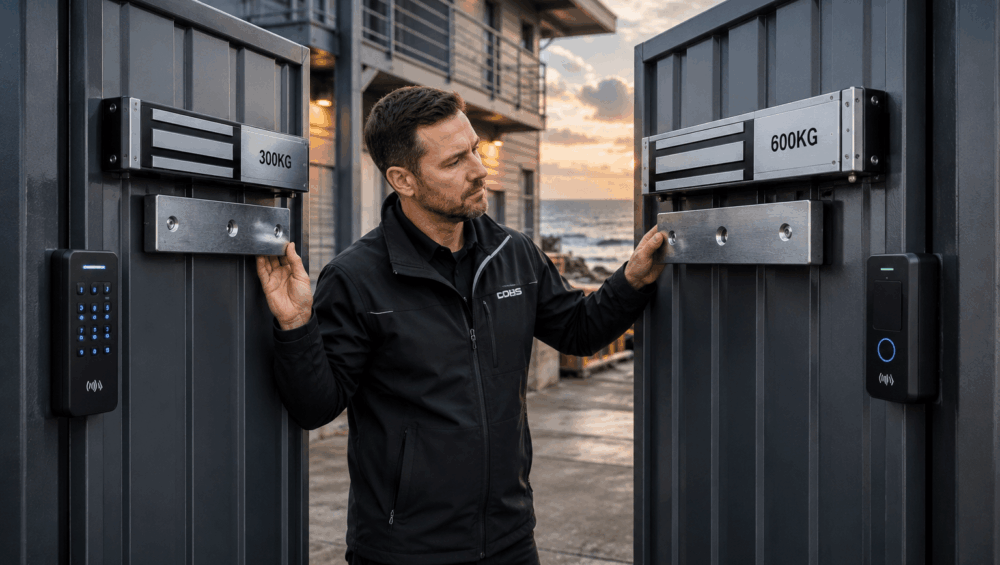
Outdoor security enclosures present challenges that go beyond basic access control. Wind loading, vibration, temperature fluctuations, and exposure to the elements can all affect gate alignment and lock performance.
Larger gates are particularly susceptible to flexing, which may reduce the contact quality between the armature plate and the electromagnet.
In these environments, installers should assess the overall rigidity of the gate structure and ongoing movement caused by weather or operational conditions. While a 300kg maglock may be suitable for some applications, a 600kg model provides an additional security margin for large, exposed gates.
Regardless of the lock rating selected, proper mounting and alignment remain critical to achieving the intended magnetic lock holding force and long-term reliability.

The Installation Factors That Influence Required Holding Force
Choosing the correct magnetic lock holding force involves more than measuring the opening itself. The physical characteristics of the gate or enclosure often have a greater impact on lock selection than the dimensions of the opening.
Installers should evaluate:
- Gate material and structural rigidity
- Gate width and leverage effects
- Frequency of operation
- Exposure to wind and weather
- Expected security threat level
- Access control integration requirements
A large but rigid gate may perform perfectly with a 300kg lock, while a smaller gate exposed to heavy wind loading may benefit from a 600kg model.
Wide gate leaves create additional leverage forces that can increase stress on locking points. Similarly, lightweight gates prone to flexing may require stronger locks to maintain reliable security.
The most effective approach is to assess the complete installation environment rather than focusing solely on opening size. Correctly matching magnetic lock holding force to structural conditions improves both reliability and security.
Read more: Why Installers Should Choose Yale Smart Locks For Residential Projects
Why More Holding Force Is Not Always Better
Many installers assume that specifying the highest available rating eliminates risk. In practice, this approach can create unnecessary complications.
Larger maglocks typically involve:
- Increased power consumption
- Larger physical dimensions
- Higher purchase costs
- Additional mounting challenges
A 600kg lock installed on a lightweight aluminium gate may offer little real-world improvement compared to a properly installed 300kg model.
Over-specification can also create aesthetic and practical issues where mounting space is limited. Some gates simply lack the structural capacity to utilise the additional holding force effectively.
The objective should be to select the most appropriate magnetic lock holding force for the application. Correct specification delivers better value, simpler installation, and long-term reliability.

Common Installer Mistakes When Specifying Maglocks
Even experienced installers can encounter problems when specifying magnetic locks. Understanding common mistakes helps avoid performance issues later.
- Selecting Based Only on Door Size
Many installers focus solely on opening dimensions. A larger gate does not automatically require a higher-rated lock. Structural rigidity, traffic levels, and environmental conditions often play a more important role.
- Ignoring Gate Flex and Alignment
Gate movement can significantly reduce effective holding force. Flexing structures may prevent full contact between the armature plate and magnet, reducing lock performance and increasing wear.
- Using Inadequate Power Supplies
Maglocks require stable voltage and sufficient current. Undersized power supplies can reduce magnetic strength and create intermittent locking issues that compromise security.
- Poor Armature Mounting
The armature plate must align correctly with the magnet face. Improper mounting can reduce contact area, decreasing the effective magnetic lock holding force and increasing failure risks.
- Forgetting Environmental Conditions
Outdoor environments present unique challenges. Wind, moisture, vibration, and temperature changes can all influence long-term lock performance. Ignoring these factors often leads to premature issues and unnecessary service calls.
Integrating Maglocks into Complete Access Control Systems
A magnetic lock is only one component of a complete access control solution. Installers should consider how the lock integrates with:
- Access control readers
- Credential management systems
- Exit buttons
- Emergency release devices
- Fire system interfaces
- Backup power systems
- Lock status monitoring
Access credentials, visitor management, and user permissions all influence overall site security. Likewise, integrating intercom systems can streamline visitor access while maintaining security standards.
Safety requirements must also be addressed. Emergency egress, fire alarm integration, and fail-safe operation are critical considerations in many installations.
Ultimately, overall security depends on the entire access control ecosystem, not simply the magnetic lock holding force rating.
Selection Checklist for Installers
| Question | 300kg Likely Suitable | 600kg Likely Suitable |
| Lightweight enclosure? | ✓ | |
| High-risk site? | ✓ | |
| Large gate leaf? | ✓ | |
| Indoor application? | ✓ | |
| Industrial compound? | ✓ |
Use this checklist as a starting point rather than a strict rule. The best choice depends on balancing structural characteristics, environmental exposure, security requirements, and system design. When uncertain, evaluate the complete installation rather than focusing solely on the lock specification.
In Conclusion
Selecting the right magnetic lock holding force is about matching the lock to the application, not simply choosing the highest available rating.
A 300kg maglock may provide excellent performance for equipment enclosures, utility cabinets, and many pedestrian gates. Meanwhile, 600kg models deliver additional benefits for industrial compounds, critical infrastructure, and higher-risk environments.
Successful specification requires installers to assess gate construction, environmental exposure, alignment quality, security requirements, and overall system integration. The lock itself is only one part of the security solution.
At DHS, we supply professional-grade smart locks, access control systems, intercom solutions, and integrated security products designed for reliable long-term performance. Contact our team for expert advice on selecting the ideal magnetic lock holding force and access control solution for your next installation project.
FAQs
Is a 300kg maglock strong enough for a gate?
In many cases, yes. A properly installed 300kg maglock is suitable for pedestrian gates, utility enclosures, and many commercial access control applications. Suitability depends on gate construction, security requirements, and environmental conditions, rather than on gate size alone.
When should I choose a 600kg magnetic lock?
A 600kg maglock is often appropriate for industrial compounds, critical infrastructure sites, commercial plant rooms, and locations where increased resistance to forced entry is required. It may also be beneficial for larger gates that are exposed to wind or are frequently used.
Does a higher holding force improve access control security?
Not necessarily. While increased holding force can improve resistance to physical attack, overall security depends on proper installation, access control credentials, monitoring, system integration, and gate construction quality.
Can poor installation reduce maglock holding force?
Absolutely. Misalignment, inadequate mounting, poor armature contact, unstable power supplies, and structural movement can all significantly reduce effective holding force, regardless of the lock’s rated capacity.
Do outdoor gates require stronger maglocks?
Sometimes. Outdoor gates are exposed to wind loading, vibration, temperature changes, and structural movement. These factors may justify a higher holding-force rating, but the correct choice depends on the specific installation environment and gate design.