Gate material affects not only the architectural aspect but also the structural supports, fabrication methods, automation equipment, safety devices, and long-term maintenance requirements of the entire entrance.
A practical commercial gate material comparison should therefore look beyond colour, finish and initial fabrication cost. Aluminium and structural steel can both be used for commercial automated gates, but they create different frame rigidity, finished gate weight, wind resistance, corrosion protection and motor demand.
Neither material is universally better. The most appropriate option depends on the gate design, site environment, opening size, security requirements and expected daily usage.
Let’s discover the best material for your gates!
Aluminium and Structural Steel: What Builders Are Actually Comparing
When assessing aluminium against structural steel, it is important to compare their fully fabricated gate assemblies, which may use different frame dimensions, wall thicknesses, bracing methods, coatings, and support hardware.
Aluminium gates are generally lighter and more corrosion-resistant. Their lower mass can make them easier to transport, lift and automate. However, aluminium has lower stiffness than structural steel, so larger sections, thicker walls, or additional bracing may be necessary for wide or tall gates.
Structural steel gates generally provide greater stiffness and strong welded connections. They are commonly selected for heavy-duty commercial entrances, high-security applications and gates requiring substantial reinforcement. Their additional mass, however, can increase the demands on foundations, hinges, wheels, operators and lifting equipment.
Take a look at the comparison table below:
| Selection factor | Aluminium gate | Structural steel gate |
| Typical weight | Lower | Higher |
| Rigidity | Depends heavily on section design | Generally higher |
| Corrosion behaviour | Naturally resistant, but not immune | Requires effective protection |
| Handling | Easier to transport and lift | Additional lifting equipment may be required |
| Automation demand | Often lower | Often higher |
| Fabrication | Requires suitable aluminium welding expertise | Commercial steel fabrication is widely available |
| Typical applications | Architectural, coastal and lightweight gates | Heavy-duty, wide and security-focused gates |
Structural Strength, Gate Rigidity and Opening Size
Strength and stiffness are related, but they are not the same. A gate frame may be strong enough to avoid structural failure while still allowing excessive sagging, twisting or deflection.
Rigidity is particularly important for automated gates because the gate must follow a consistent, predictable path.
Sliding gates need to remain aligned with their wheels, track, guide rollers and drive rack. Even moderate frame distortion can cause rack misalignment, uneven rolling resistance or contact between the gate and surrounding structures.
Swing gates place significant leverage on their hinges, particularly at the outer edge of a long leaf. Excessive deflection can affect closing alignment, electric locking and operator geometry.
In terms of Ccantilever gates, a substantial portion of the frame is unsupported as it spans the opening, imposing additional structural demands. The gate frame, counterbalance section, and cantilever hardware must work together as a single engineered assembly.
Steel’s greater stiffness can make it an attractive option for wide, tall, heavily clad gates. On the other hand, aluminium can still be suitable, but the fabricator may need to use larger hollow sections, thicker-walled profiles, gussets, or internal reinforcement to achieve the required performance.
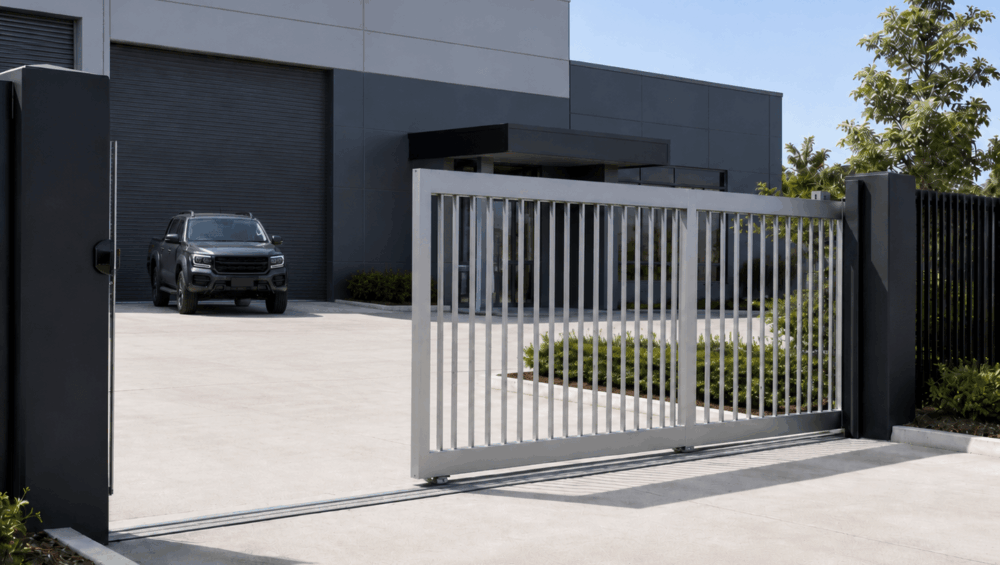
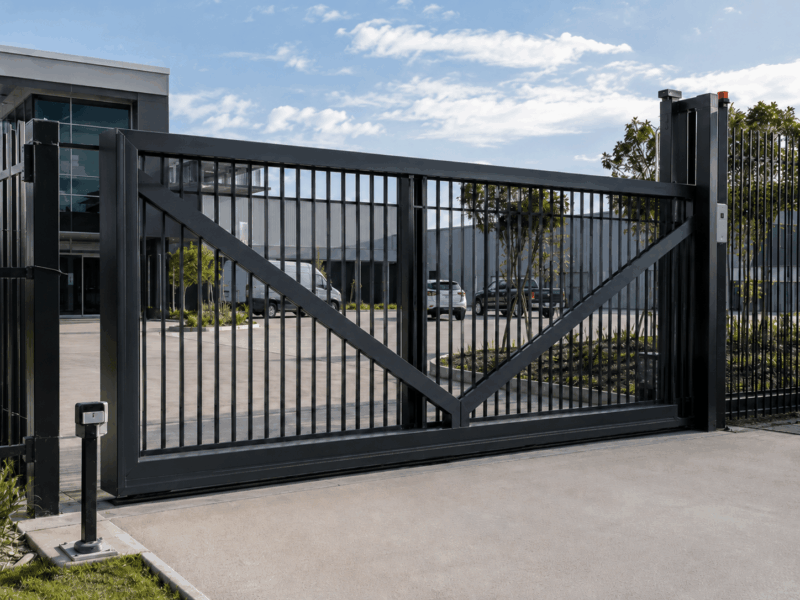
In any commercial gate material comparison, the infill design is just as important as the overall dimensions. An open aluminium gate with vertical bars may place relatively little wind load on the frame. A fully clad aluminium gate of the same height and width can behave very differently during strong winds.
Read more: Wind-Load Calculations for Commercial Sliding Gates: Avoiding Structural Failure
How Gate Material Changes the Automation System
Gate automation equipment should never be selected solely according to the width of the opening. The finished material, frame construction, and infill affect the total moving mass, inertia, wind resistance, and the forces transferred through the gate hardware.
This part of the commercial gate material comparison is particularly important because a gate may appear straightforward on an architectural drawing while creating substantial mechanical loads once fabricated.
Gate Weight and Operator Capacity
A structural steel gate will often require a higher-capacity operator than an aluminium gate of similar dimensions. However, nominal gate weight is only one selection factor.
A well-balanced steel sliding gate running on correctly sized wheels and a level track may move more easily than an aluminium gate with undersized rollers or alignment problems. Likewise, a lightweight swing gate with solid cladding and high wind exposure may attract greater demand from operators.
Starting and Stopping Forces
A heavier gate has greater inertia. The operator must accelerate it smoothly and bring it to a predictable stop without creating excessive impact.
Poorly controlled acceleration and deceleration can place unnecessary stress on other elements, including:
- Drive racks and pinions
- Gate hinges
- Mechanical stops
- Wheel assemblies
- Operator gearboxes
- Mounting brackets
- Structural posts
Modern gate controllers may provide adjustable speed profiles, soft start and soft stop functions. These features are valuable, but they do not compensate for a gate that is mechanically difficult to move.
Duty Cycle and Traffic Volume
Duty cycle refers to how frequently the operator can run without overheating or experiencing excessive wear. A commercial entrance with concentrated morning and afternoon traffic may require an intensive-use or continuous-duty operator.
Builders should determine the expected number of daily cycles before specifying the gate motor. Vehicle numbers, shift changes, delivery schedules, visitor access and future occupancy should all be considered.
Sliding Gate Implications
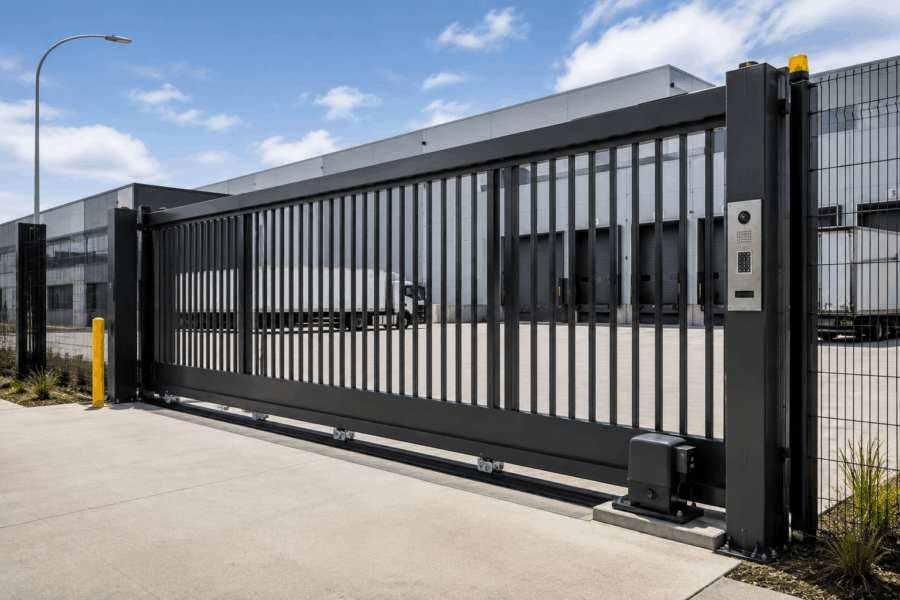
For sliding gates, increased mass can magnify small defects in the track and support system. A heavier steel gate may require larger wheels, higher-capacity bearings and more substantial foundations.
The design for a sliding gate should account for:
- Track straightness and level
- Wheel diameter and load rating
- Number and spacing of wheels
- Rack support and alignment
- Guide roller capacity
- Foundation movement
- Drainage around the track
- Debris accumulation
The gate should move smoothly by hand before the operator is connected. A motor for heavy-duty sliding gates should not be used to overcome binding, misalignment or excessive rolling resistance.
Swing Gate Implications
Swing gates create different loads because the operator must move the leaf through an arc while resisting leverage, wind and changes in geometry.
Long steel leaves can impose substantial forces on hinges, posts and mounting points. Operator capacity must be assessed against both the leaf length and its weight.
Important considerations while designing and installing a swing gate include hinge rating, opening angle, operator geometry, mounting dimensions, gate stops and reinforcement around the motor brackets.
Safety Configuration
Heavier gates can increase the potential impact force if a vehicle, person or object enters the movement area. Appropriate safety design may include photocells, induction loop detectors, pressure-sensitive safety edges and controlled speed settings.
Safety devices should be planned during the gate design stage rather than added after fabrication. Their mounting points, cable pathways and control requirements can affect the frame, posts and electrical preparation.
Before approving the operator, builders should confirm:
- Estimated finished gate weight
- Gate geometry and centre of gravity
- Infill type and wind exposure
- Expected number of daily cycles
- Wheel, hinge and guide capacities
- Required safety devices
- Motor capacity against the completed design
Corrosion Resistance, Coatings and Environmental Exposure
Corrosion resistance is a major consideration when comparing aluminium and steel, particularly for outdoor or other aggressive environments.
Aluminium forms a natural oxide layer that helps protect the underlying material, suitable for coastal, humid and exposed sites. However, it does not mean that aluminium is completely corrosion-proof.
Aluminium can experience pitting, staining, crevice corrosion and galvanic corrosion. Galvanic corrosion may occur when aluminium comes into contact with incompatible metals in the presence of moisture.
Suitable fasteners, isolation washers, sealants and drainage details may be necessary where aluminium frames connect to steel components.
Structural steel relies more heavily on a properly specified protective system. Depending on the application. Powder coating can provide an attractive finish, but coating only the visible surfaces may leave internal cavities, cut edges, weld areas and drainage points vulnerable.
For a reliable comparison of commercial gate materials, builders should consider not only the base material but also how the finished gate sheds water and how damaged finishes can be repaired.
Fabrication, Transport and On-Site Installation
Material choice can directly affect the construction programme, transport plan and installation methodology.
Aluminium’s lower weight can simplify delivery and manual handling. It may also reduce the lifting load placed on surrounding structures. However, aluminium fabrication requires appropriate welding experience, proper preparation, and careful control of heat-induced distortion.
Structural steel fabrication is widely available, and the material can provide robust welded connections and convenient reinforcement for hinges, racks, brackets and locks. The trade-off is increased transport weight and potentially greater reliance on mechanical lifting equipment.
Before manufacturing begins, builders should confirm the maximum transportable gate dimensions and whether the frame will be delivered as one piece or assembled on site.
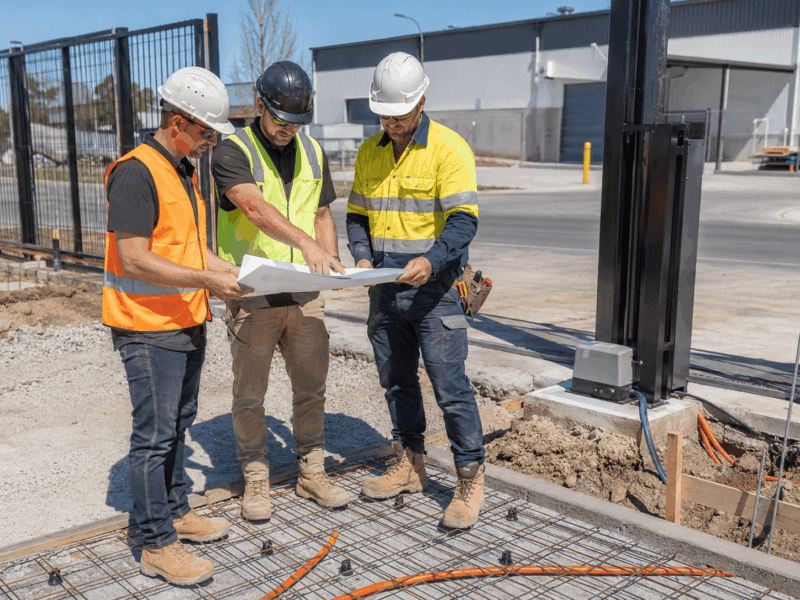
Other practical matters include site access, lifting positions, crane reach, storage space and protection of the finished coating. The installation sequence also needs to be coordinated. Posts, tracks, foundations, conduits, drainage and power supplies should be positioned according to the approved gate and automation design.
Finally, the gate fabricator and automation supplier should review the shop drawings together before manufacturing begins. This helps ensure that the frame includes suitable reinforcement and that the selected operator can be installed using the correct geometry.
Cost, Maintenance and Whole-of-Life Value
The least expensive fabricated gate is not always the lowest-cost automated entrance. A complete commercial gate material comparison should consider the structural, mechanical and maintenance consequences of the material selection.
Overall, project costs may include:
- Raw material and fabrication
- Structural posts and foundations
- Freight and lifting equipment
- Gate motor capacity
- Hinges, wheels, guides and racks
- Corrosion protection
- Safety equipment
- Preventative maintenance
- Future repairs or recoating
Aluminium may reduce freight, lifting, and automation costs due to its lower mass. However, larger frame sections, thicker walls and specialist fabrication can increase the initial price.
Structural steel may provide economical rigidity for heavy-duty designs. At the same time, its additional weight may require larger hardware, stronger foundations and a more powerful operator.
Maintenance requirements between these two gate commercial materials also differ. Aluminium may require less coating maintenance, but welds, fasteners, brackets and dissimilar-metal connections should still be inspected.
Steel gates should be checked for damaged coatings, rust around welds, water retention inside sections and corrosion around ground-level components. Small coating defects should be repaired before they develop into more extensive deterioration.
When Aluminium May Be Preferable
Aluminium may be the stronger project choice when lower gate weight is a priority, the site is exposed to coastal or humid conditions, and the architectural finish is important. It can also suit entrances requiring opening without excessive frame deflection or complex reinforcement.
When Structural Steel May Be Preferable
Structural steel may be more appropriate when the gate requires high rigidity, impact resistance or substantial welded reinforcement. It is often suitable for wide, tall, heavy and security-focused gates, provided that an appropriate corrosion-protection system can be applied and maintained.
Frequently Asked Questions About Commercial Gate Materials
Is aluminium strong enough for a commercial automated gate?
Yes. Aluminium can be suitable when the frame sections, wall thicknesses, bracing and connections are designed for the gate dimensions, infill and site conditions.
Is a steel gate always more secure than an aluminium gate?
Not necessarily. Security depends on the complete assembly, including the frame design, infill, hinges, guides, locks, access-control equipment and resistance to forced entry. Steel often provides greater stiffness, but a properly designed aluminium gate can meet the security requirements of many commercial properties.
Does an aluminium gate need a smaller motor?
Its lower weight may reduce operator demand, but motor selection must also account for opening width, friction, gradient, wind load, duty cycle and gate geometry. The operator should be selected based on the completed gate design rather than on the frame material alone.
Which material is better for coastal commercial properties?
Aluminium often offers an advantage in corrosive environments, although suitable fasteners and galvanic isolation remain important. Properly galvanised structural steel may also perform well when the protective system is designed for the site exposure.
Can structural steel gates be powder coated without galvanising?
Powder coating can provide a durable and attractive finish, but the appropriate system depends on the environmental exposure and required design life. For demanding outdoor or coastal sites, galvanising or a duplex system may provide more robust long-term protection.
Final Thoughts
A successful commercial gate material comparison should involve the gate frame, foundations, supports, automation equipment, electrical preparation and safety system.
Aluminium can reduce moving weight and simplify corrosion management, while structural steel can provide greater rigidity for large or security-focused designs. The correct choice depends on the complete project rather than a single material characteristic.
Builders should coordinate the gate fabricator and automation supplier before shop drawings are approved. Early collaboration can prevent incorrect motor sizing, damaged coatings and expensive on-site alterations.
Digital Home Systems supports builders, electricians, and commercial installers with ultimate gate and door solutions, including design, product specification, installer coordination, commissioning, and ongoing technical support. Contact us before fabrication begins to ensure the operator, safety equipment, and control system are matched to your completed gate design.