An office access control system may appear to work perfectly during normal business hours. However, during an evacuation drill, an employee may discover that the panic bar sticks or the emergency door release unit fails to unlock the door as expected.
That is why emergency exit door compliance Australia requirements must be considered from a life-safety perspective, not only as part of everyday building security.
A typical office exit can combine mechanical panic hardware, electronic locks, access control panels, fire alarm interfaces, door closers, monitoring contacts and emergency release controls. Every component must perform its intended function under normal and emergency conditions.
What Emergency Exit Door Compliance Australia Means for an Office
Understanding emergency exit door compliance Australia starts with identifying the purpose and approved classification of each door. Not every external office door is a required exit, and not every access-controlled door is a fire-rated doorset.
A normal external door may simply provide everyday entry and exit. A required exit door forms part of the building’s approved evacuation route. Meanwhile, a fire-rated doorset is specifically designed and installed to protect an opening in fire-resistant construction.
An access-controlled security door can fall into one or more of these categories. For example, an office stairwell door may provide electronic access control while also functioning as a fire door and required exit.
The relevant compliance framework may include:
- The edition of the National Construction Code adopted in the relevant jurisdiction
- State or territory building legislation
- The building’s occupancy permit or certificate of final inspection
- Essential safety measure schedules or maintenance determinations
- Relevant Australian Standards
- Fire engineering reports and approved performance solutions
- Manufacturer installation and maintenance instructions
Required exit doors generally need to be openable from the egress side without occupants having to search for a key or wait for reception staff. The approved opening action and hardware configuration will depend on the building, occupancy, door type and approved design.
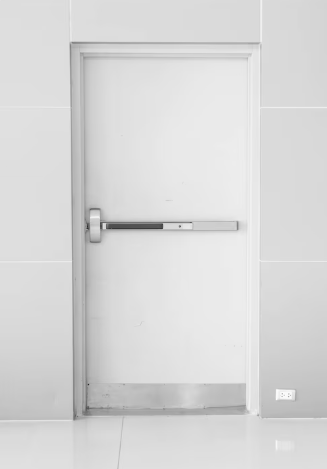
Understanding Panic Bars, Exit Devices and Fail-Safe Electronic Locks
Several mechanical and electronic components may need to work together with a secure door to provide safe egress. Proper emergency exit door compliance Australia testing therefore looks beyond what the access control software displays on screen.
Panic bar or push-bar device: A panic bar releases the mechanical latch when pressure is applied across the bar. It provides a large, obvious operating surface that an approaching occupant can use quickly.
Lever-operated exit hardware: Some doors may use approved lever hardware rather than a panic bar. Whether this arrangement is suitable depends on the approved building design and applicable requirements.
Electromagnetic lock: A maglock uses electrical power to hold an armature plate against the magnet. Because the lock depends on power, an approved release arrangement is essential where it is installed on an egress door.
Electric strike: An electric strike controls entry by releasing the latch at the door frame. Depending on the lock and hardware arrangement, the inside lever or panic device may still provide mechanical free egress without requiring an electronic command.
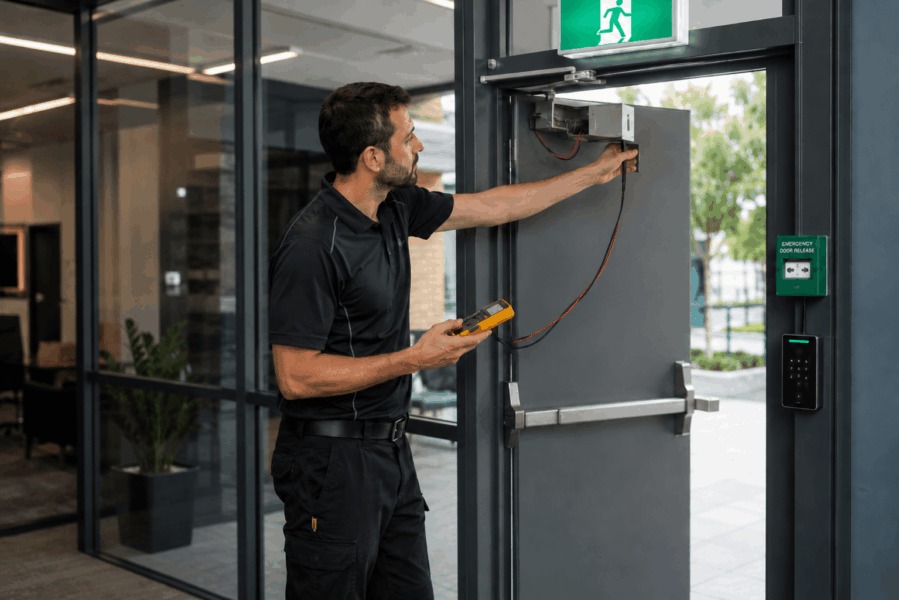
Emergency door release unit: Often called an emergency break-glass or emergency release button, this device provides a direct method of releasing electronic locking where required by the approved design.
Fire alarm interface: This interface sends the required command to the door system when the fire alarm or sprinkler system is activated.
Door closer: The closer returns the door to its closed position where required. Its adjustment affects closing speed, latching and the effort needed to open the door.
Door position monitoring: A door contact reports whether the door is open, closed or being held open. This information can support security monitoring, but it does not prove that the locking hardware has released correctly.
Importantly, “fail-safe” does not simply mean that the access control software displays an unlocked symbol. The physical locking device must release under the emergency and power-loss conditions specified in the approved design.
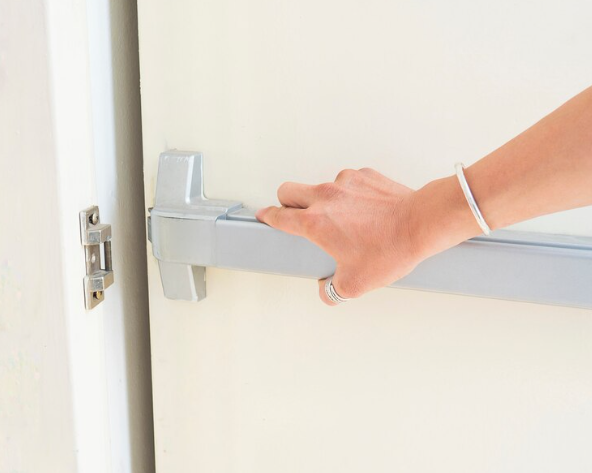
Office Manager’s Emergency Exit Door Testing Procedure
A practical emergency exit door compliance Australia inspection begins with the approved building documents and finishes with a record of what was tested. Office managers can perform basic observations, but electrical isolation and control panel testing should be handled by qualified contractors.
Step 1: Review the Approved Maintenance Requirements
Before testing a door, locate the documents that define how the building and its essential safety measures are meant to operate. This reviewing process may include:
- Occupancy permit or certificate of final inspection
- Essential safety measures schedule
- Maintenance schedule or determination
- Previous inspection reports
- Access control drawings
- Door and locking hardware schedules
- Fire engineering documentation
- Outstanding defect notices
The inspection frequency and testing method should come from the approved documentation rather than an arbitrary online timetable.
For Victorian buildings constructed or altered since 1 July 1994, the applicable essential safety measures, required performance and maintenance frequency are included with the occupancy permit or certificate of final inspection.
Step 2: Inspect the Exit Route Before Touching the Door
A working door is not enough if occupants cannot reach or pass through it safely. Walk the route leading to the exit and inspect the surrounding area. During this step, check that:
- Corridors and paths of travel are clear
- Furniture, deliveries and storage do not restrict access
- The door can open through its required travel
- Floor mats do not catch under the door
- Exit signs remain visible
- No chain, bolt or temporary locking device has been added
- Equipment does not hide the panic bar or emergency release unit
- The external landing or path beyond the door is usable
Step 3: Perform a Normal Egress Test
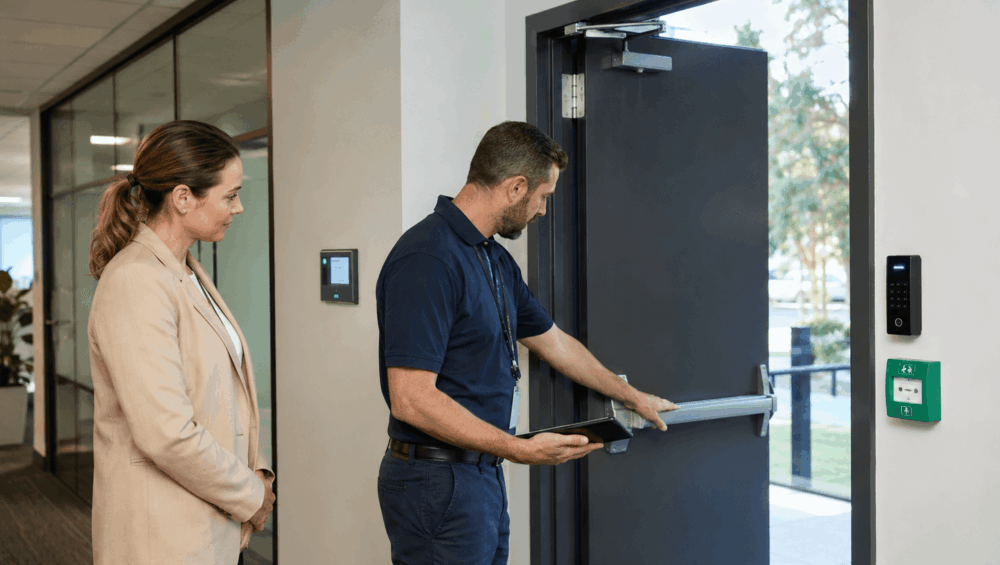
Stand on the egress side and approach the door as an unfamiliar occupant might during an emergency. Operate the panic bar, lever or approved exit device. Confirm that the latch retracts without sticking and that one clear, intuitive action opens the door. The occupant should not need a card, PIN, key or assistance from reception.
During this step, listen and feel for signs such as:
- Grinding or scraping
- Delayed lock release
- A panic bar that binds
- A latch that only retracts after repeated pressure
- A door leaf rubbing against the frame or floor
- An electronic lock that buzzes but remains physically secure
For paired doors, check both leaves where the approved arrangement requires them to operate. Also confirm that door coordinators, flush bolts and sequence controls behave correctly.
Step 4: Observe Closing and Relatching
Open the door fully, release it and allow it to close naturally. The door should not slam dangerously, stop before reaching the frame or rebound after contact. Where latching is required, confirm that the latch engages consistently, without requiring someone to pull or push the door into position.
During this investigation, watch for:
- Dropped or worn hinges
- Misaligned latches and strikes
- Excessive closer resistance
- Floor or weather-seal interference
- Door leaves are closing in the wrong sequence
- Unauthorised wedges or hold-open devices
A door can release correctly and still be defective if it does not close, latch or preserve its required fire and security function.
Step 5: Test Electronic Release Functions Safely
Electronic testing should be planned with the access control contractor, fire services contractor, building manager, and, where necessary, the alarm monitoring company. The contractor should verify the approved operation of:
- Emergency release controls
- Request-to-exit devices
- Access control relays
- Lock power supplies
- Backup batteries or emergency power
- Fire alarm and sprinkler interfaces
- Door monitoring contacts
- Automatic door operators
- System restoration after testing
Office managers may witness the test and confirm the user experience, but they should not pull cables, bypass relays or isolate electrical circuits unless they are authorised and qualified to do so.
Step 6: Record the Result at Door Level
Generic notes such as “exit doors checked” provide little value when a fault needs to be traced later. Each door should have a clear identification number or location description. It is recommended to record:
- Door identification and location
- Test date and time
- Hardware and functions tested
- Pass, fail or further-investigation result
- Symptoms observed
- Photographs where useful
- Contractor name and company
- Defect priority
- Required repair
- Repair completion date
- Retest result
Any door for preventing immediate egress should be treated as a priority safety defect. It should not be left until the next routine service simply because the door still works occasionally.
How to Test Fail-Safe Electronic Doors Without Creating a New Risk
Testing electronic egress systems requires coordination because a single door may connect to multiple separate systems. A test could trigger an alarm response, interrupt office operations or leave a secure entrance permanently unlocked.
A comprehensive emergency exit door compliance Australia test may need to verify:
- Normal credential-based entry
- Mechanical exit from the secure side
- Activation of the emergency release control
- Loss of power to the locking system
- Activation of the relevant fire alarm interface
- Operation while backup power is active
- Correct door monitoring at the control panel
- Proper restoration and reset after testing
The emergency release device should not merely send a software request through the same controller that may have failed. The contractor should verify the approved physical release path and confirm that the locking hardware actually changes state.
For related access planning, see DHS’s guide to smart lock emergency override options.
Where an automatic operator is installed on an exit route, the team should also verify what happens when mains power is lost or the fire interface operates. The door may need to permit manual operation, release an associated lock or move to another approved state. Read more about the Emergency Manual Operation of Automatic Swing Doors.
During testing, do not:
- Pull random access control or fire interface cables
- Switch off an entire office distribution board
- Activate the fire alarm without notifying monitoring services
- Leave tested doors unlocked afterwards
- Bypass a relay to silence a recurring fault
- Test a busy doorway without controlling pedestrian movement
The objective is to safely reproduce approved operating conditions, not to create a new hazard while investigating the original one.
Common Defects That Can Make an Exit Door Unsafe
Some exit door faults are obvious, while others only appear during emergency release or power-loss testing. For effective emergency exit door compliance Australia, defects should be identified and repaired promptly.
- Mechanical Defects
A panic bar may stick, require repeated pressure, or fail to fully retract the latch. Doors can also drop on their hinges or fail to close and latch correctly. On paired doors, in addition, incorrect sequencing can also affect safe egress.
- Electronic Defects
A controller may show that a door is unlocked even though the magnetic lock remains energised. Other issues include failed release devices, disconnected fire interface relays, incorrect power supplies or faulty backup batteries. A strong magnetic lock holding force does not prove that the door will release safely in an emergency.
- Operational Defects
Furniture, stock or equipment may block the exit path or restrict the door’s movement. Exit doors should not be chained, hidden behind stored items or held open with unauthorised wedges. Staff should never need a card, code or key to leave during an emergency.
- Documentation Defects
Poor records can allow faults to remain unresolved. Door numbers should match service reports, repairs should be documented, and each repaired door should be retested to confirm safe operation.
Inspection Records, Repair Escalation and Management Responsibilities
Maintaining emergency exit door compliance Australia is usually a shared process rather than the responsibility of one contractor.
The office manager generally conducts routine visual inspections and reports any defects. The building owner is responsible for maintaining applicable essential safety measures and compliance records. Fire-services contractors test the relevant fire system and interfaces, while access control technicians inspect locks, relays, controllers and power supplies.
A building surveyor or fire engineer may be needed where the approved building solution is unclear or where alterations are proposed.
Maintenance frequency must be taken from the building’s approved documents and relevant service requirements. Standards Australia currently lists AS 1851:2012 and Amendment 1:2016 as the current routine-service publications for fire protection systems and equipment.
In Victoria, building owners must maintain applicable essential safety measures, retain records of inspections and repair work, and prepare annual essential safety measures reports. Occupiers must keep exits and paths of travel functional and unobstructed.
Clear escalation is equally important. A sticky panic bar may need a door hardware technician, while a maglock that remains energised may require an access control specialist. A failed fire interface may involve both the fire-services provider and the access control contractor.

Maintain Safe Egress Without Compromising Security
Reliable emergency exit door compliance Australia depends on more than installing a panic bar or selecting a fail-safe lock. Instead, the door, frame, mechanical hardware, electronic locking, power supply, fire interface, and management procedures must work as a single coordinated system.
Office managers can support safer buildings by keeping exit routes clear, arranging qualified testing and documenting every defect through to repair and retesting. Any condition that could delay immediate egress deserves prompt attention.
Digital Home Systems supports commercial projects involving access control, magnetic locks, electric strikes, emergency release controls, and automatic door systems. Our team works with builders and facility managers to help diagnose integration faults and specify practical upgrade options.
Explore DHS gate and door solutions and access control products for commercial entrances, or contact our team to discuss an exit door system that is not operating as expected. When life-safety and security functions overlap, coordinated product selection and professional integration can make all the difference.
Frequently Asked Questions
Does every Australian emergency exit door require a panic bar?
No. The correct hardware depends on the building classification, occupant numbers, door location and approved NCC solution.
Can an emergency exit door have an electronic lock?
It may be possible where the locking and release arrangement satisfies the applicable NCC provisions and approved building design.
Should an electronic exit door unlock during a power failure?
The required response depends on the approved locking arrangement. A qualified contractor should verify the physical result rather than relying only on the access-control dashboard.
How often should office exit doors be tested?
Follow the frequency listed in the occupancy permit, essential safety measures schedule, maintenance determination and applicable service standards.
Can an office manager conduct the test?
Office managers can complete routine visual and functional observations. Electrical isolation, fire-system activation and compliance certification should be handled by appropriately qualified professionals.
What should happen when a panic bar sticks?
Record the defect, control access to the affected area and arrange urgent assessment. Do not lubricate, dismantle or bypass life-safety hardware without appropriate technical guidance.