Wind loading is among the most underestimated risks in commercial gate projects. Builders often focus on gate dimensions, automation systems, and access requirements. When commercial sliding gate wind load requirements are not properly assessed, the consequences can be significant. Excessive wind pressure can cause gate derailment, structural deformation, motor overload, accelerated hardware wear, and serious safety liabilities. Meanwhile, commercial gates continue to increase in size across warehouses, logistics facilities, industrial developments, and infrastructure projects.
This guide explains the key calculations and design considerations builders should understand when assessing commercial sliding gate wind load during specification and construction.
Why Wind Loads Matter More for Commercial Sliding Gates Than Most Builders Realise
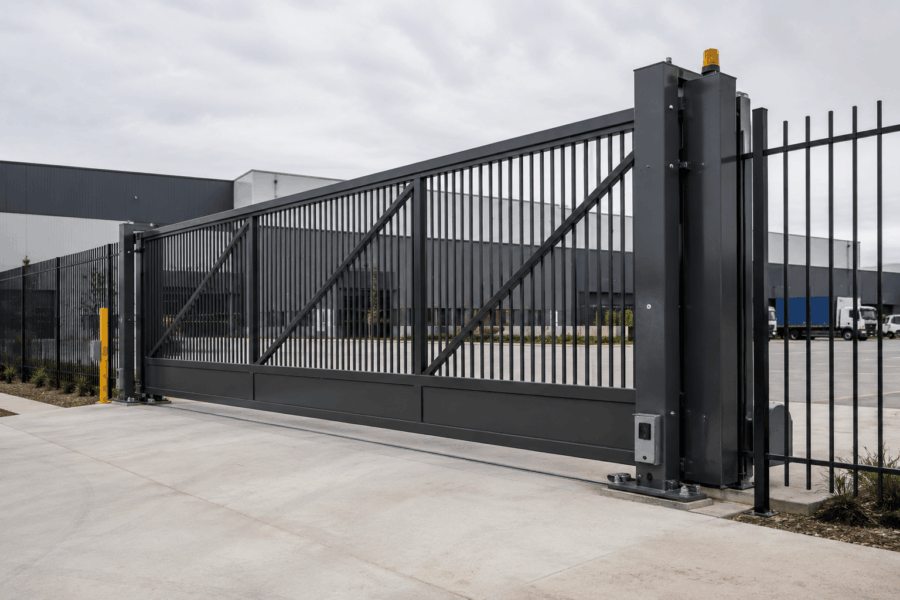
Large commercial sliding gates function as structural elements as much as access control systems. Their size and exposed surface area make them highly susceptible to wind pressure.
The Forces Acting on Large Sliding Gates
Several forces influence gate performance simultaneously. Wind pressure exerts a continuous force on the gate surface, while gust loading produces sudden increases in pressure that can exceed average design conditions. Also, the gate’s own weight generates constant loads on tracks, rollers, and support structures. Operational forces from opening and closing cycles add further stress to the system.
When these forces combine, the resulting structural demands can be substantial. A gate that appears robust may experience loads far greater than expected during severe weather conditions.
Common Failure Scenarios
Many commercial gate failures can be traced back to inadequate wind load assessment. Bent gate frames often occur when wind pressure exceeds structural capacity. Guide rollers may wear prematurely or fail due to excessive side loading. Track systems can distort under repeated lateral forces, causing operational issues and alignment problems.
Motors are particularly vulnerable. Increased wind resistance forces automation systems to work harder, leading to overheating, premature wear, or complete failure. During storms, gates may become unstable or impossible to operate safely.
Why Commercial Sites Face Higher Risks
Warehouses and industrial estates often feature large open spaces that allow wind to accelerate across sites. Logistics facilities commonly require wide gate openings, increasing exposed surface area. Coastal developments experience stronger, more consistent wind conditions, while open-air commercial precincts offer limited natural shielding.
These factors significantly increase the importance of accurate commercial sliding gate wind load calculations.
Related: Secure Sliding Gates For Warehouses And Logistics Centres
Understanding Wind Pressure and Gate Surface Area Calculations
Before selecting gate hardware or automation equipment, builders should understand the fundamentals of wind force calculations.
Wind pressure increases rapidly as wind speed rises. A modest increase in wind velocity can generate disproportionately larger forces on a gate structure. This relationship is why gates that perform adequately in moderate conditions may experience significant stress during storms.
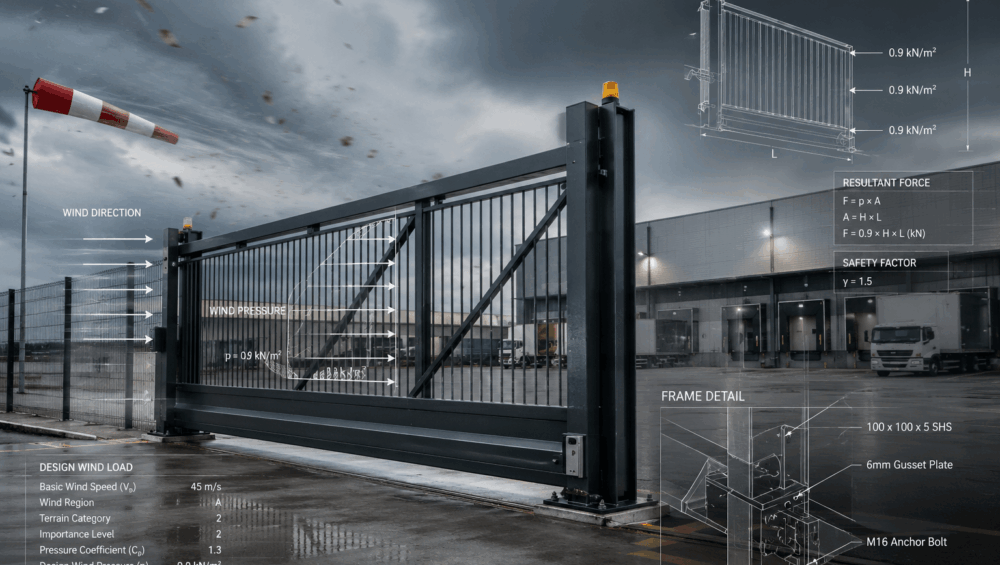
From an engineering perspective, wind pressure is generally calculated using recognised standards that consider wind speed, terrain conditions, shielding effects, and regional classifications.
The key takeaway for builders is that doubling wind speed does not simply double loading. The resulting force increases much more dramatically.
Calculating Effective Gate Area
The effective surface area of a gate directly influences the amount of wind force it experiences. Solid gates offer the greatest resistance to wind because their entire surface acts as a barrier.
Perforated gates reduce loading by allowing some airflow through the structure. Mesh gates provide even greater pressure reduction, while louvred designs can significantly decrease wind resistance when properly engineered.
The percentage of open area becomes a critical design consideration when evaluating wind exposure.
The Critical Formula Builders Should Understand
The basic wind force equation is: F=P\times A
Where:
- F = Wind force
- P = Wind pressure
- A = Effective gate area
This simple formula demonstrates why larger gates face substantially higher wind loads. Even moderate increases in gate dimensions can significantly increase the total force acting on the structure.
6 Critical Factors That Influence Commercial Sliding Gate Wind Load
Numerous variables affect commercial sliding gate wind load calculations and should be considered during specification.
Gate Width and Height
Larger gates naturally create larger wind-catching surfaces. A six-metre-wide gate experiences considerably more force than a three-metre gate under identical wind conditions. As dimensions increase, frame design, roller selection, post sizing, and automation requirements must also be upgraded accordingly.
Builders should avoid assuming that standard hardware can simply be scaled up for larger openings.
Solid vs Perforated Infill Panels
Solid steel panels generate the highest loads because they block airflow entirely. Perforated sheet designs can significantly reduce pressure while maintaining privacy and security. Expanded mesh systems often offer an excellent balance between security, visibility, and wind performance.
In many cases, selecting a perforated design allows for more efficient structural solutions and lower project costs.
Local Wind Region Classification
Australia’s wind regions play a critical role in gate design. Projects in higher-wind regions require stronger structural components, heavier-duty hardware, and more robust engineering solutions. Wind region classifications are defined under Australian Standards and vary significantly across the country.
Builders should always verify the applicable regional classification during project planning.
Coastal and Cyclonic Exposure
Coastal sites present unique challenges. Exposure to strong ocean winds often substantially increases design requirements. In northern regions subject to cyclonic activity, wind loading may become a primary structural consideration in gate design.
Ignoring these conditions can result in premature failures and compliance issues.
Terrain Categories and Shielding Effects
Surrounding terrain influences how wind interacts with a gate. A gate installed within a dense urban environment may benefit from shielding provided by nearby buildings. Conversely, gates located in open industrial estates, rural developments, or exposed transport facilities may experience much higher wind forces.
Engineering assessments often account for terrain categories when determining design loads.
Gate Frame Construction and Reinforcement
Reinforced steel members, additional bracing, stronger welds, and engineered support structures help resist wind-induced deformation. Frame stiffness is particularly important for maintaining alignment and protecting automation components.
The structural design should always match anticipated commercial sliding gate wind load requirements.
Related: Motor Torque Calculations For Sliding Gate Automation
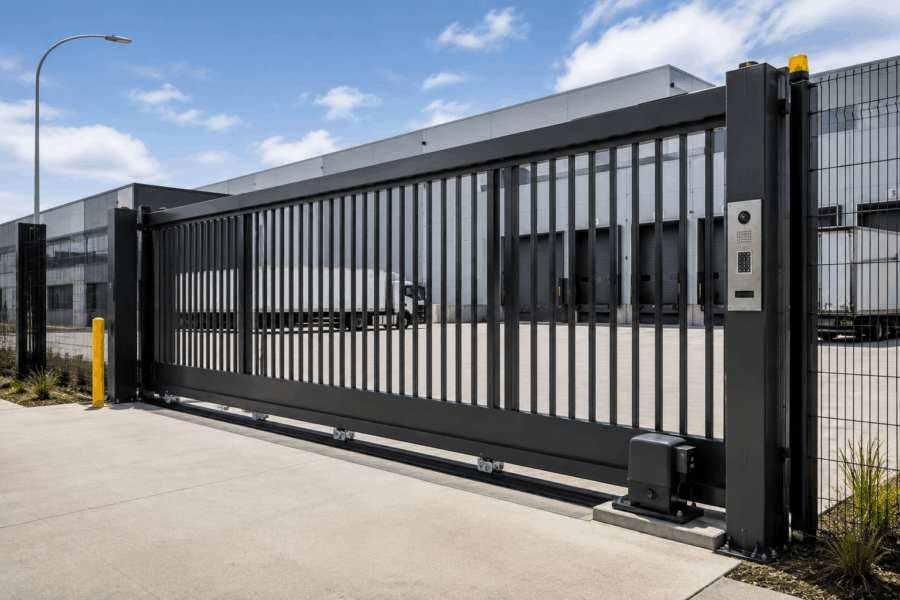
How Australian Wind Standards Affect Commercial Gate Design
Compliance with Australian standards is essential for commercial gate projects. Australian wind design standards provide methodologies for determining site-specific loading requirements.
These standards consider factors such as wind regions, terrain classifications, topography, shielding conditions, and structure dimensions. For commercial gates, these calculations help engineers establish appropriate design loads and structural specifications.
Many projects require engineering review or certification. Industrial facilities frequently require documented structural verification. Government projects often specify formal engineering approvals. Transport infrastructure and critical facilities typically impose stricter compliance requirements.
High-wind regions may also trigger additional certification obligations depending on local regulations and project scope.
Before approving gate designs, builders should obtain relevant supporting documentation. Engineering certifications help confirm structural adequacy. Wind load calculations provide evidence of design assumptions. Manufacturer testing data demonstrates performance capabilities, while compliance documentation supports regulatory requirements.
Structural Components Most Vulnerable to Wind-Induced Failure
The following components are particularly susceptible to wind-related damage.
| Component | Typical Failure Mode | Cause |
| Gate frame | Bending | Excessive pressure |
| Guide rollers | Wear or breakage | Side loading |
| Track system | Distortion | Repeated wind loads |
| Posts | Deflection | Insufficient footing design |
| Motors | Overload | Wind resistance |
| Limit systems | Misalignment | Structural movement |
During design reviews, builders should assess how each component responds to anticipated commercial sliding gate wind load conditions.
A strong gate frame alone does not guarantee reliability if rollers, tracks, or support posts remain under-designed. Similarly, motor selection should account for environmental loads rather than simply gate weight.
Related: Wind Load Impact On Swing Gate Automation Performance
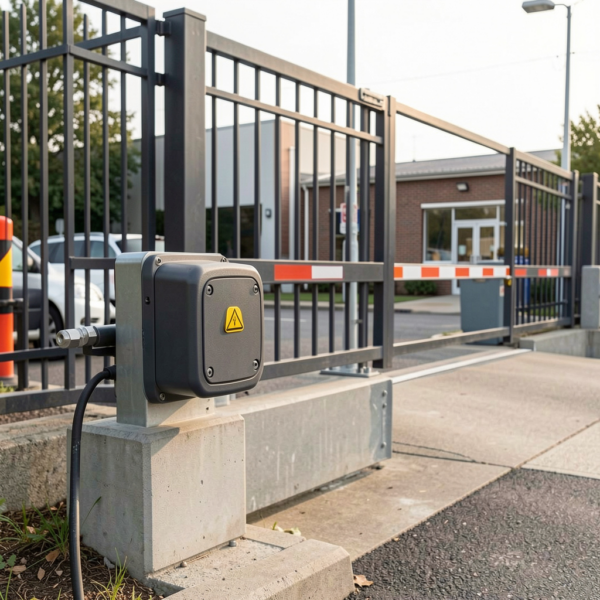
Design Strategies That Reduce Wind Loads Without Compromising Security
Perforated infill panels provide one of the most practical solutions by allowing airflow through the gate surface. Expanded mesh systems offer excellent wind performance while maintaining security. Louvred designs can further reduce pressure by directing airflow through controlled openings.
Structural improvements such as reinforced frame members, larger guide assemblies, and heavy-duty track systems improve resistance to wind-induced stresses. Appropriate motor sizing ensures automation systems remain reliable during adverse conditions.
Some projects also benefit from wind-locking hardware that stabilises gates during severe weather events.
By reducing overall wind pressure, builders can often minimise hardware requirements, lower maintenance costs, and improve long-term reliability.
Commercial Sliding Gate Wind Load Checklist for Builders and Specifiers
Before finalising any commercial gate project, verify the following:
✓ Confirm site wind classification
✓ Verify gate dimensions
✓ Calculate effective surface area
✓ Assess surrounding terrain conditions
✓ Review structural engineering requirements
✓ Check manufacturer wind load ratings
✓ Validate post and footing design
✓ Confirm motor suitability
✓ Review storm-event operating procedures
Completing this checklist helps ensure accurate commercial sliding gate wind load assessment before construction begins.

FAQ: Commercial Sliding Gate Wind Load
How much wind can a commercial sliding gate withstand?
The answer depends on gate size, construction, location, and engineering design. Some gates are designed for moderate exposure, while others are engineered to withstand extreme wind conditions in cyclonic regions.
Are mesh gates better than solid gates in high-wind areas?
Yes. Mesh gates generally allow airflow through the structure, significantly reducing wind pressure and structural loading compared to solid-panel designs.
Do wind loads affect gate motor selection?
Absolutely. Increased wind resistance places additional demands on gate motors. Selecting an undersized motor can lead to reduced reliability, higher maintenance costs, and premature failure.
Can existing gates be upgraded for higher wind resistance?
In many cases, yes. Upgrades may include frame reinforcement, stronger support posts, improved guide systems, wind-locking devices, or replacement infill panels designed to reduce wind loading.
Are wind load calculations required for commercial developments?
Many commercial projects require documented engineering assessments, particularly in high-wind regions, government facilities, industrial sites, and infrastructure developments.
In Conclusion
Accurate commercial sliding gate wind load assessment is a critical part of successful gate design. While automation systems often receive significant attention, many structural failures originate from inadequate consideration of environmental loads. By evaluating wind regions, gate dimensions, surface area, terrain conditions, and structural components early in the design process, builders can significantly reduce the risk of deformation. Proper wind load calculations also support compliance with Australian standards and improve long-term system reliability.
Speak With DHS About Commercial Gate Design
Planning a commercial gate project? The team at Digital Home Systems (DHS) can assist with gate automation selection, structural design considerations, wind load requirements, and compliance support. Contact DHS today to discuss your project and ensure your commercial sliding gate solution delivers long-term safety, performance, and reliability.