
In commercial environments, security alerts normally rely on audible alarms to signal danger. Sirens, buzzers, and alarms have long been the first line of defence for notifying occupants of safety risks. However, modern sites become larger, noisier, and more complex. Therefore, relying solely on sound is no longer enough.
This is where a visual warning device for security becomes essential. In many real-world situations, sound alone can fail – whether it’s drowned out by machinery, blocked by building layouts, or simply ignored due to alarm fatigue. Visual alerts, such as flashing strobes and LED beacons, provide a powerful complement by ensuring alerts are seen, not only heard.
Today’s security strategies are evolving towards layered, multi-sensory systems. By incorporating visual alerts alongside audible alarms, businesses can create more reliable protection across a wide range of environments.
Comparing Sound-Only vs Visual Security Alarm Systems
Traditional alarm systems have relied heavily on audible sirens to deter intruders and alert occupants. Nowadays, many commercial environments benefit from combining audible and visual alerts into a unified alarm strategy.
A sound-only alarm system works well when occupants are nearby and environmental noise levels are low. However, in many modern commercial settings, such as warehouses, factories, apartment complexes, retail centres, and outdoor sites, sound alone may not always deliver an effective warning.
A visual warning device for security adds an additional layer of awareness by using flashing LEDs or strobe lighting to immediately attract attention. These alerts remain visible even in noisy environments where sirens may be ignored, drowned out, or difficult to localise.
The combination of visual and audible alerts creates several operational advantages:
- Faster recognition of alarm events
- Improved deterrence for intruders
- Better visibility for staff during emergencies
- Enhanced awareness in outdoor or high-noise environments
- Improved accessibility for hearing-impaired occupants
Visual alerts can also help security personnel quickly identify the exact location of an alarm trigger, especially across larger facilities or multi-building sites.
For commercial installers and integrators, combining visual and audible alerts also improves overall system versatility. Modern smart security systems can trigger lighting effects, perimeter alerts, notifications, and automation routines simultaneously during an intrusion event.
This layered approach creates a more effective security response compared to relying on sirens alone, particularly in environments where visibility, reaction speed, and deterrence all play critical roles.
The Limitations of Sound-Only Alarm Systems
While audible alarms remain important, there are clear limitations to their use as the sole method of alerting. In many commercial settings, these weaknesses can significantly reduce response times and overall effectiveness.
- High-noise environments
In industries such as manufacturing, construction, and processing plants, background noise levels can be extremely high. Machinery, tools, and constant activity often mask alarm sounds, making it difficult for staff to hear a siren. Even a loud alarm can become ineffective in these conditions, delaying critical responses.
- Distance and layout challenges
Large facilities such as warehouses, logistics hubs, and multi-building sites present another challenge. Sound dissipates over distance and can be blocked by walls, shelving, or equipment. In these cases, an audible alarm may only be clearly heard in certain areas, leaving other zones unaware of a potential threat.
- Human factors
Not all occupants perceive sound the same way. Workers may have hearing impairments, or they may be required to wear hearing protection under workplace safety regulations. In these scenarios, relying solely on sound excludes a portion of the workforce from receiving timely alerts.
- Delayed response risks
Even when alarms are heard, they don’t always provide clear direction. Staff may struggle to identify where the alarm is coming from or what triggered it. This confusion can lead to hesitation, which is critical in emergencies where every second counts.
- Alarm fatigue
In busy environments, frequent alerts for testing, minor events, or false alarms can cause people to become desensitised. Over time, staff may begin to ignore or delay responding to alarms. This will reduce their effectiveness when a real threat occurs.
These challenges highlight the need for a visual security alert system that complements sound. By adding a visual layer, businesses can bridge these gaps and ensure alerts are noticed immediately.
What Is a Visual Warning Device in Security Systems?
A visual warning device for security is an alert mechanism that communicates a warning through sight rather than sound. Common examples include flashing strobes, LED beacons, and high-intensity light indicators that activate upon a security event.
These devices are typically integrated into broader alarm systems and are triggered by events such as intrusion detection, perimeter breaches, fire alarms, or safety incidents. When activated, they provide a clear, attention-grabbing signal that can be seen from a distance or through complex layouts.
There are several types of alarm strobe application depending on the environment:
- Indoor strobes, used in offices, retail spaces, and internal zones to alert occupants quickly
- Outdoor strobes, designed for visibility in open areas like car parks and building exteriors
- High-intensity strobes, suitable for large or brightly lit environments
- Directional lighting, used to guide occupants towards exits or highlight specific zones
The key advantage of visual alerts is their universality. Unlike sound, which depends on hearing ability and environmental conditions, visual signals are immediately recognisable to anyone within line of sight. This makes them an essential component of any modern commercial warning device strategy.
Key Use Cases Where Visual Alerts Outperform Sound Alone
There are many real-world scenarios in which a visual warning device for security performs better than sound alone. These environments demonstrate why visual alerts are becoming a standard feature in commercial security systems.
- Industrial and manufacturing sites
Workers operating heavy machinery often face extremely high noise levels. In these settings, audible alarms can be completely drowned out. A flashing strobe provides an instant, unmistakable signal that cuts through the noise and ensures workers are aware of potential danger.
- Warehouses and logistics hubs
Large shelving systems, constant forklift movement, and expansive floor plans can block or distort sound. Visual alerts, however, can be seen throughout aisles and open spaces, making them far more effective at communicating alarms throughout the facility.
- Commercial buildings with multiple zones
Offices, retail centres, and mixed-use developments often have separate zones or floors. A visual security alert helps occupants quickly identify which area is affected. This helps improve response times and reduce confusion during incidents.
- Outdoor perimeters and car parks
External environments introduce additional challenges such as wind, traffic noise, and open space. Sound dissipates quickly outdoors, reducing its effectiveness. A bright, flashing strobe, on the other hand, remains highly visible and acts as both a warning and a deterrent.
- Night operations
In low-light conditions, visual alerts become even more effective. A flashing strobe stands out dramatically in the dark, making it easier to attract attention and signal a problem.
- Emergency evacuation scenarios
During evacuations, visual alerts reinforce audible instructions. They can guide occupants towards exits and provide reassurance that an alarm is active, improving overall safety outcomes.
In each of these scenarios, combining a sound and a visual warning device for security creates a more reliable and responsive system than sound alone.

Case Study Example: Visual Security Alerts for a Commercial Warehouse
A commercial warehouse operator managing after-hours inventory storage faced recurring security concerns around unauthorised perimeter access during overnight periods. While the facility already had motion sensors and an audible alarm system installed, management found that sirens alone were not deterring intruders or quickly alerting nearby security staff.
To strengthen the site’s security response, the integrator deployed a combined visual and audible warning solution using smart outdoor sirens with integrated strobe lighting.
The upgraded system was configured to trigger multiple responses simultaneously whenever perimeter sensors detected suspicious activity:
- Outdoor sirens activated immediately
- High-visibility flashing strobe lights illuminated the affected area
- Mobile notifications were sent to site managers
- CCTV recording markers were triggered for faster footage review
- Access control systems automatically locked selected entry points
The addition of visual alerts significantly improved incident visibility across loading zones and external access areas. Security personnel reported faster identification of alarm locations, particularly during noisy operational periods or adverse weather conditions.
The warehouse operator also noted an improvement in the effectiveness of deterrence. Highly visible flashing alarms created a stronger perception of active monitoring, making the site less attractive to opportunistic intruders.
This example highlights why a visual warning device for security is increasingly part of modern commercial security strategies, not simply as an accessory, but as an integrated component of a smarter alarm system.
Read more: Designing Perimeter Alert Systems for Warehouses Using Z-Wave Outdoor Sirens
How Visual Warning Devices Improve Security Outcomes
Integrating a visual warning device for security into an alarm system significantly enhances overall performance. One of the most important benefits is faster detection and response. When an alert is both heard and seen, it’s much harder to miss.
Visual alerts also improve situational awareness. By clearly indicating the presence of an alarm and, often, its location, strobes help people understand what’s happening and where action is needed. This clarity reduces hesitation and confusion during critical moments.
From a compliance perspective, visual warning devices support workplace safety standards in environments where hearing protection is required. They ensure all occupants, regardless of hearing ability, receive the same level of warning.
There’s also a strong deterrent effect. A visible alarm signal makes it clear that a security system has been triggered, increasing the likelihood that intruders will abandon their actions. This visible exposure adds another layer of protection beyond detection alone.
Most importantly, visual devices support multi-sensory alerting. By combining audio and visual cues, businesses create redundancy in their systems. If one method fails, the other still provides protection.
Integrating Visual Warning Devices into Smart Security Systems
Modern smart security systems make it easier than ever to deploy a visual warning device for security as part of a fully integrated solution. Technologies like Z-Wave and KNX allow seamless communication between sensors, controllers, and alert devices.
These systems enable flexible and scalable configurations across commercial properties, ensuring visual alerts can be deployed wherever they’re needed most.
Common integration approaches include:
- Pairing with sensors: A visual warning device for security can be triggered by motion sensors, door/window contacts, and shock sensors, ensuring immediate alerts during intrusion attempts.
- Tamper and breach notifications: Strobes can activate when a device is tampered with or a perimeter is breached, adding another layer of protection.
- Access control integration: Visual alerts can work alongside access control systems to signal unauthorised entry or forced access events.
- Automation scenarios: Systems can be programmed to activate strobes in response to after-hours breaches, panic button presses, or specific alarm conditions.
- Remote monitoring: Smart controllers allow users to monitor and manage alerts remotely, ensuring real-time awareness even when off-site.
- Scalability: Visual alerts can be deployed across multiple buildings or zones, making them ideal for growing businesses and complex facilities.
This level of integration ensures that a commercial warning device is not just reactive but also part of a proactive and intelligent security strategy.
Read more: Integrating Outdoor Sirens with Access Control & Intrusion Detection
Product Spotlight: Combining Sound and Visual Alerts with the Vision Outdoor Siren
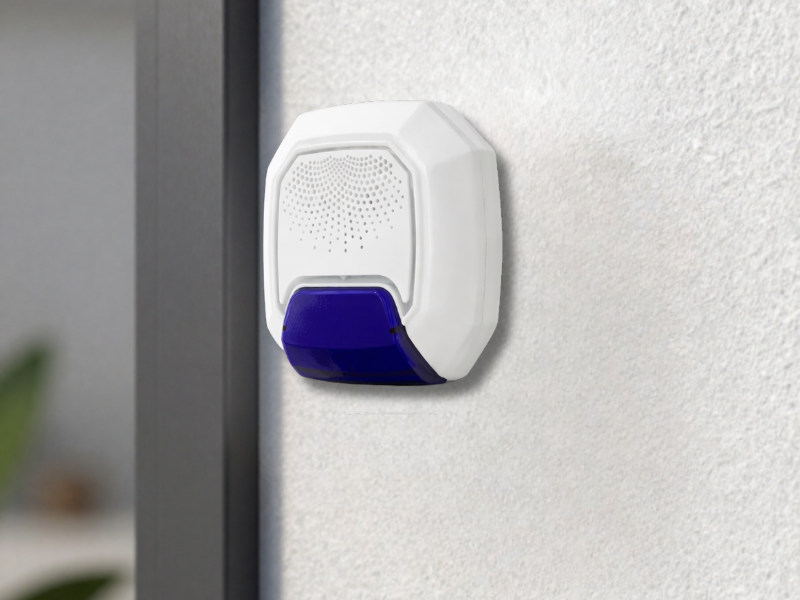
For businesses looking to implement both audible and visual alerts, the Vision Z-Wave Outdoor Siren offers a practical and powerful solution. This device combines a high-output 115 dB siren with a bright flashing strobe, delivering a complete visual warning device for security in a single unit.
Designed for flexibility, the siren integrates seamlessly with Z-Wave systems, making it compatible with a wide range of sensors and controllers. Its wireless design simplifies installation, while its IP66-rated enclosure ensures reliable performance in harsh outdoor conditions.
Battery-powered operation with long life expectancy provides dependable performance without complex wiring.
In real-world applications, this dual-function device excels in:
- External perimeter protection, where both sound and light deter intruders
- Car parks and loading docks, where visibility is critical
- Warehouses and industrial facilities, where noise can mask alarms
By combining a powerful siren with a bright strobe, it supports both audible and visual security alert strategies, ensuring maximum coverage and effectiveness. It’s also compatible with a wide range of Z-Wave sensors, allowing businesses to build a fully integrated and scalable security system.
FAQs
What is a visual warning device in a security system?
A visual warning device for security uses flashing lights or strobes to provide visible alerts during alarm events. These devices are commonly integrated into commercial alarm and intrusion detection systems.
Why are visual alarms important in commercial security?
Visual alarms improve awareness in noisy environments, help identify alarm locations more quickly, and provide stronger visual deterrence to potential intruders.
Can visual warning devices work with smart security systems?
Yes. Modern visual warning devices can integrate with smart security platforms, access control systems, sensors, CCTV, and automation workflows.
Are visual warning devices suitable for outdoor installations?
Many commercial-grade visual warning devices are designed for outdoor environments and feature weather-resistant housings to ensure reliable operation.
What industries benefit most from visual security alarms?
Warehouses, retail centres, apartment complexes, schools, factories, and commercial buildings often benefit from visual alarm systems because they improve visibility and emergency response.
Can a visual warning device for security help hearing-impaired occupants?
Yes. Visual alerts improve accessibility by ensuring alarm events remain noticeable even when audible warnings may not be effective for all occupants.
Why Visual Alerts Are Essential in Modern Security Design
In current commercial environments, it’s clear that sound-only alarms are no longer sufficient. A visual warning device for security provides the visibility needed to address the challenges of modern sites.
Visual alerts play a critical role in layered security systems, from improving detection and response times to enhancing safety compliance and deterrence. They ensure that alarms are not just heard but seen, making them far more effective.
Solutions like the Vision Z-Wave Outdoor Siren demonstrate how combining sound and visual alerts can deliver a more complete and future-ready approach to security. For businesses looking to upgrade their systems or design smarter security solutions, now is the time to consider integrating visual alerts.
Need help getting started?
Contact DHS today to request a technical service or connect with a certified installer and build a smarter, more reliable security system tailored to your site.
Read more: Scaling Alarm Systems Across Multi-Site Commercial Clients