Automatic door operators have evolved significantly over the past decade, with advances in motor technology. While the motor is only one component of a complete automatic door system, it has a major influence on movement quality and long-term operating costs.
Today, brushless DC motor automatic doors are common in commercial projects, even though many existing buildings still operate reliable automatic doors powered by traditional AC motors. Choosing between these technologies is not as simple as comparing motor wattage. The right solution also depends on many factors, including door weight, operating frequency, gearbox design, electronic controls, heat management and the availability of replacement components.
This guide compares brushless DC motor automatic doors with traditional AC systems, helping you understand where each technology performs best and what to consider before specifying a heavy-duty automatic entrance.
How Brushless DC and Traditional AC Automatic Door Motors Work
Selecting the right motor technology starts with understanding how each system operates. Although both ultimately move an automatic door, they achieve this in very different ways.
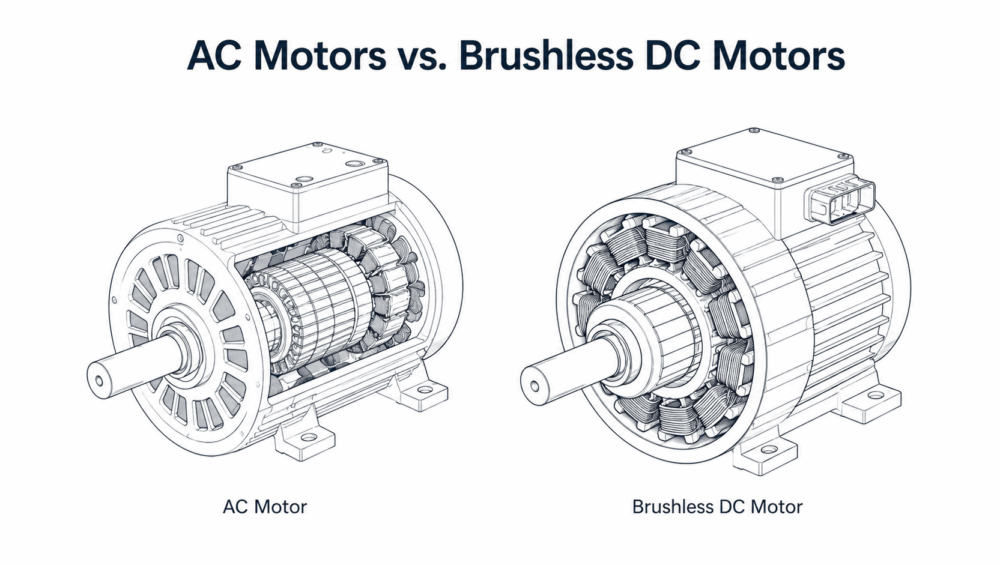
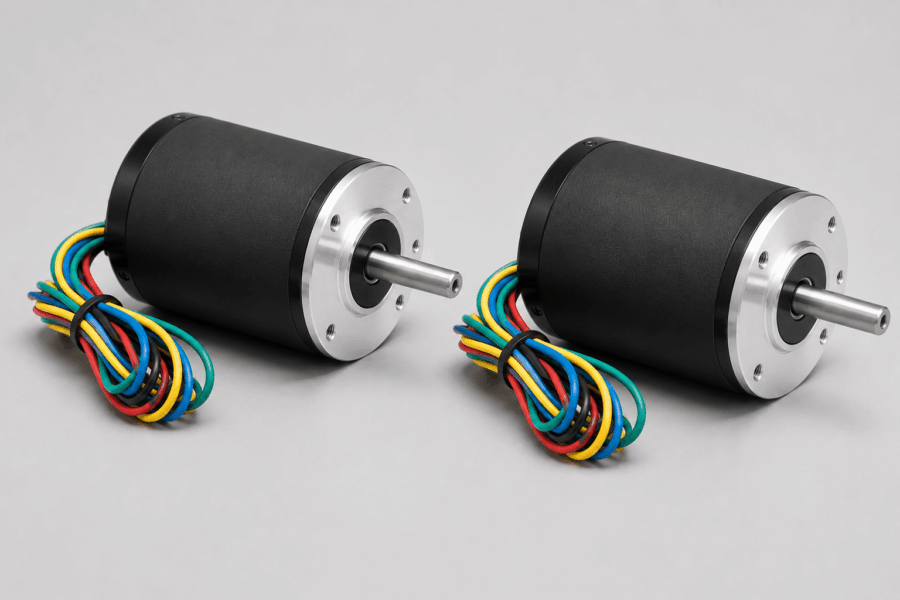
Brushless DC Motors
A brushless DC (BLDC) motor uses permanent magnets within the rotor while electromagnetic windings remain fixed in the stator. Instead of relying on mechanical brushes to switch electrical current, the motor uses electronic commutation controlled by an integrated controller.
This controller constantly receives information from Hall sensors or rotary encoders, allowing it to determine the exact rotor position. Using pulse-width modulation (PWM), the controller adjusts voltage and current many times every second to precisely regulate speed and torque.
Because the controller continuously monitors movement, brushless DC motor automatic doors can deliver smooth acceleration, controlled deceleration and highly accurate positioning. Installers can usually program multiple operating parameters, including opening speed, closing speed, braking distance and obstacle sensitivity.
Importantly, the term brushless simply refers to the absence of mechanical brushes. It does not mean the motor operates independently; it relies heavily on sophisticated electronic control.
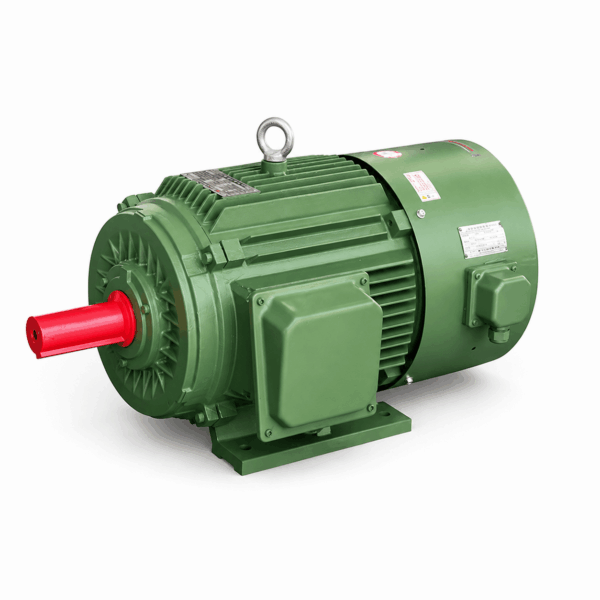
Traditional AC Motors
Traditional automatic door operators commonly use alternating current motors that generate rotational movement from the changing AC magnetic field.
Many legacy operators use relatively simple control arrangements, relying on components such as capacitors, relays, contactors, limit switches and reduction gearboxes to regulate movement.
Unlike modern BLDC systems, older AC operators operate at fixed speeds or offer only limited adjustment. Braking may rely on mechanical mechanisms or basic electrical controls, while door positioning is often determined through physical limit switches rather than continuous encoder feedback.
These systems have earned a reputation for durability because of their straightforward design and familiarity among experienced technicians. Many continue operating reliably after years of commercial service when maintained correctly.
Core Technology Comparison Between Brushless DC Motor Automatic Doors vs Traditional AC Motors
| Comparison Area | Brushless DC Motor | Traditional AC Motor |
| Motor commutation | Electronic | Alternating-current field |
| Speed regulation | Fully programmable | Usually fixed or limited |
| Position feedback | Encoder or Hall sensor | Limit switches or indirect feedback |
| Starting behaviour | Soft programmable start | Often more abrupt |
| Braking | Electronic deceleration | Mechanical or basic electrical braking |
| Controller dependency | High | Low to moderate |
| Wear components | Fewer internal contact parts | Capacitors, relays and mechanical controls |
| Typical installation | Modern programmable operators | Legacy or simpler heavy-duty operators |
Heavy-Duty Performance Comparison for Commercial Automatic Doors
In commercial environments, a genuinely heavy-duty automatic door system must reliably handle demanding operating conditions such as large door leaves, high daily opening cycles, extended operating hours, wind pressure, high-friction seals and entrances where downtime is unacceptable.
For this reason, brushless DC motor automatic doors should always be assessed alongside the operator’s rated door weight, duty cycle and gearbox capacity rather than motor specifications alone.
Performance Comparison Between Brushless DC Motor Automatic Doors vs Traditional AC Motors
| Performance Criterion | Brushless DC Motor Automatic Doors | Traditional AC Motor Automatic Doors | Installer Implication |
| Low-speed torque | Strong, precisely controlled | Depends on motor and gearbox | Smoother heavy door movement |
| Starting movement | Programmable acceleration | Often immediate | Less mechanical shock |
| Speed adjustment | Wide electronic adjustment | Narrow adjustment | Greater commissioning flexibility |
| Braking | Progressive electronic control | Mechanical or fixed braking | Reduced closing impact |
| High-cycle operation | Well suited when correctly rated | Reliable but can generate more heat | Verify operator duty cycle |
| Heat generation | Higher efficiency | More waste heat under repeated starts | Cooling remains important |
| Noise | Quiet operation | More audible motor and relay noise | Better for hospitals and offices |
| Obstruction response | Continuous monitoring | Often relies on separate controls | Improved safety response |
| Energy consumption | Lower during variable operation | Higher during fixed-speed running | Savings on busy entrances |
| Controller complexity | Advanced electronics | Simpler controls | Different diagnostic approach |
| Field repairability | Module replacement common | Individual components often repairable | Different servicing strategy |
| Retrofit compatibility | May require complete upgrade | Easier like-for-like replacement | Assess complete system |
The greatest advantage of brushless DC motor automatic doors lies in movement quality rather than raw power. Electronic speed control enables gradual acceleration, smoother low-speed travel and progressive braking, placing less stress on belts, brackets, rollers and other moving components.
However, installers should avoid assuming every BLDC operator is automatically suitable for heavy entrances. A lightweight brushless operator may still be unsuitable for a large commercial sliding door, while a properly engineered AC operator with an appropriate gearbox may provide decades of dependable service.
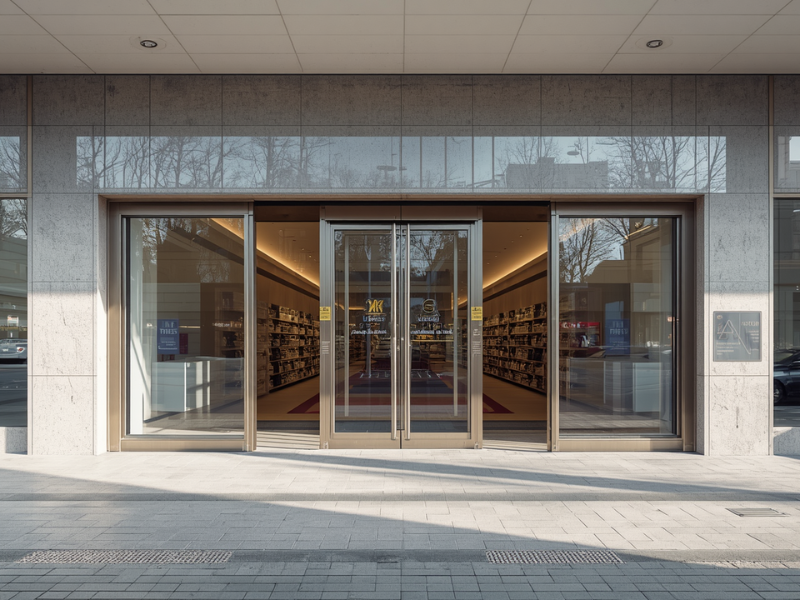
Installation, Commissioning and Controller Differences
From an installation perspective, the biggest difference between the two technologies is the commissioning process.
Modern brushless DC motor automatic doors place much of the setup process inside the electronic controller. During commissioning, many operators automatically learn door characteristics including travel distance, opening and closing positions, door resistance, acceleration profiles, braking points, hold-open times, reduced-speed zones and obstruction sensitivity.
Encoder feedback allows the controller to monitor door movement with remarkable accuracy. Because of this, installers must ensure the door operates smoothly by hand before starting an automatic learning cycle. Excessive friction, damaged rollers or poor alignment may be interpreted by the controller as an obstruction or incorrect operating parameter.
On the other hand, traditional AC operators often involve more manual adjustments. Installers may need to physically position limit switches, adjust mechanical stops, replace capacitors or fine-tune separate speed-control devices depending on the operator design.
A practical commissioning checklist includes:
- Confirm the door moves freely by hand before powering the operator.
- Measure the actual door weight and leaf dimensions.
- Verify the operator’s rated duty cycle.
- Confirm mains voltage and power supply requirements.
- Complete the manufacturer’s automatic learning procedure.
- Set acceleration and braking conservatively.
- Test opening sensors and all safety devices.
- Perform repeated operating cycles under realistic conditions.
- Record programmed values for future servicing.
Increasing motor force should never be used to compensate for binding guides, damaged hinges, worn rollers or excessive seal pressure. Mechanical issues should always be corrected before electronic adjustments are made.
Maintenance, Fault Diagnosis and Whole-of-Life Serviceability
Although brushless DC motor automatic doors eliminate mechanical brushes, they are not maintenance-free systems. Every automatic door operator still contains components requiring routine inspection throughout its service life.
Gearboxes, belts, pulleys, bearings, rollers, hangers, door guides, controllers, power supplies, encoders and safety devices all remain critical maintenance items regardless of motor type.
BLDC-related faults commonly include encoder failures, Hall sensor problems, communication errors, incorrect learning cycles, controller incompatibility, overcurrent shutdowns and power supply issues. Fortunately, many modern controllers provide detailed fault codes that assist technicians during troubleshooting.
Meanwhile, traditional AC operators often experience different types of failures, including worn capacitors, relay failures, motor overheating, brake wear, damaged limit switches, insulation deterioration and gearbox wear.
Many experienced technicians appreciate AC systems because individual electrical components can often be tested and replaced independently. By comparison, modern BLDC systems frequently rely on proprietary electronics, meaning replacement controllers or matched motor assemblies may be required.
When specifying a new automatic door operator, installers should evaluate more than the initial purchase price. Long-term availability of replacement controllers, encoder assemblies, programming tools, technical documentation, manufacturer support and spare parts can significantly affect future maintenance costs.
Selecting the Correct Motor Technology for Each Door Application
Rather than automatically preferring one technology, installers should select the motor that best matches the entrance’s operating requirements.
Brushless DC May Be Preferred When
- High daily operating cycles require automatic door operators for busy entrances to provide efficient, continuous performance.
- Smooth acceleration and braking help minimise wear on door hardware and improve user comfort.
- Low-noise operation is important in hospitals, offices, hotels and healthcare facilities.
- Precise speed adjustment allows accurate commissioning for different door sizes.
- Building automation integration is required alongside modern access control systems.
- Energy efficiency becomes important during extended daily operation.
- Advanced diagnostics simplify preventive maintenance and troubleshooting.
These characteristics make brushless DC motor automatic doors particularly suitable for airports, healthcare facilities, retail centres, office towers, apartment developments and accessible entrances.
A Traditional AC Operator May Still Be Appropriate When
- An existing AC operator remains reliable and serviceable.
- A straightforward like-for-like replacement is preferred.
- Daily operating frequency is relatively modest.
- Local technicians already support the equipment.
- Compatible replacement parts remain readily available.
- The existing operator has a proven heavy-duty performance record.
It is also important to recognise that converting an AC operator to a BLDC system is rarely a simple motor replacement. Most conversions require a compatible controller, updated power supply, encoder wiring, new harnesses, gearbox modifications and complete recommissioning of safety functions.
At Digital Home Systems, we recommend specifying the motor, controller, operator mechanics, activation devices and safety equipment as one fully coordinated automation package rather than selecting components individually.

In Conclusion
Both technologies continue to have an important place in commercial entrance automation. Brushless DC motor automatic doors deliver exceptional motion control, quieter operation, programmable performance and advanced diagnostics, making them an excellent choice for modern high-cycle installations. Traditional AC operators, however, remain dependable solutions where proven reliability, straightforward servicing and compatibility with existing infrastructure are priorities.
Rather than focusing solely on motor technology, installers should evaluate the complete automatic door operator, including the controller, gearbox, safety devices, duty cycle and long-term parts availability, to ensure the system matches the demands of the entrance.
If you’re planning a new installation, retrofit or heavy-duty commercial entrance, Digital Home Systems can help specify complete Gate & Door Solutions tailored to your project. Our team provides expert product selection, system design, technical support and reliable automatic door operators designed for long-term commercial performance.
Frequently Asked Questions
Are brushless DC motors always better for automatic doors?
Not necessarily. They generally offer superior speed control, efficiency and motion feedback, but the complete operator must still be correctly matched to the door’s weight, size and operating frequency.
Can a brushless DC motor replace an AC automatic door motor?
Usually not as a direct motor-only replacement. The controller, power supply, encoder, wiring and gearbox compatibility also need to be assessed.
Which motor is better for high-cycle automatic doors?
A correctly rated BLDC operator is often preferred because it provides smoother variable-speed control and improved efficiency. The manufacturer’s duty-cycle rating remains the most important specification.
Do brushless DC automatic door motors require maintenance?
Yes. Although the brushless DC motor has fewer wear components, the gearbox, rollers, belts, guides, controllers and safety devices still require scheduled servicing.
What should installers check before specifying a heavy-duty operator?
Confirm door weight, leaf dimensions, daily cycle count, operating environment, mechanical resistance, required opening speed, safety requirements and long-term availability of technical support.