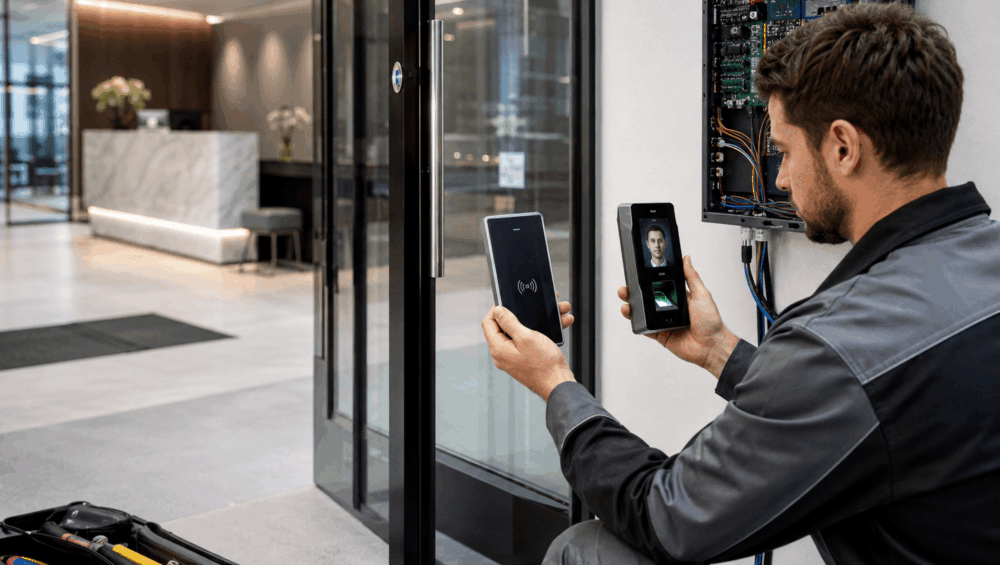
For commercial access control jobs, readers can affect how installation, commissioning, and long-term support are carried out. Installers are often asked to recommend among commercial RFID card readers, fob readers or biometric access control readers.
Both options can provide secure access control, but they create very different practical realities on-site. Commercial RFID card readers remain common because they are simple, familiar, cost-effective and easy to scale. Biometric readers can reduce lost-card issues and credential sharing, but they usually require more planning.
For installers, the best choice is not always the most advanced device. It is the reader type that suits the site conditions, user flow, security risk and support expectations.
What Are Commercial RFID Card Readers?
Commercial RFID card readers are access control devices that use cards, fobs or tags to identify authorised users at controlled entry points. When a user presents their credential near the reader, the reader detects the credential data and sends it to the access control controller. The controller then decides whether to unlock the door, release the gate, or deny access.
In commercial environments, RFID readers are commonly installed at office entrances, warehouse doors, staff-only areas, shared amenities, commercial gates, car parks, lift lobbies and multi-tenant building entries. These sites need a practical way to manage large numbers of staff, visitors and contractors.
Installers often prefer commercial RFID card readers for straightforward commercial projects because they are easy to mount and familiar to most users. They work well in high-traffic areas where people need to move quickly through an entry point.
Read more: Managing User Permissions In Large Access Control Deployments
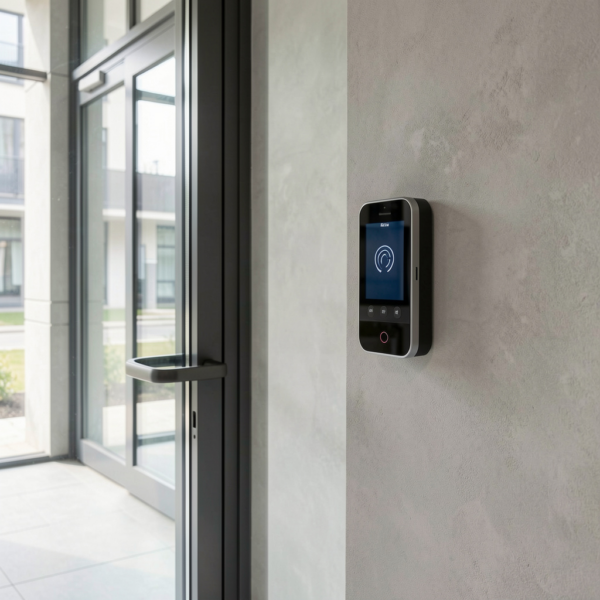
What Are Biometric Access Control Readers?
Biometric access control readers identify users through physical traits, including fingerprint, facial, palm, or vein pattern recognition. Instead of presenting a credential, the user presents a biometric feature that is matched against an enrolled profile in the access control system.
These readers are usually considered when a site wants stronger user accountability, as a card can be passed to another person, but a biometric credential is linked to the individual. This can be useful for server rooms, laboratories, executive areas, medical facilities, or warehouses with restricted stock.
However, biometric readers are not always the simplest choice for every entrance. They can be powerful when specified correctly, but performance may be affected by environment, user volume, privacy expectations, hygiene concerns and the way people naturally approach the reader during daily use.
Installation Realities: RFID vs Biometric Readers on Commercial Sites
From a buyer’s perspective, the comparison between commercial RFID card readers and biometric access often focuses on security. From an installer’s perspective, it involves mounting location, cabling, controller compatibility, commissioning time, user training, maintenance and future support.
Mounting and Positioning
RFID readers are generally more forgiving during installation because the user only needs to present a card or fob within the reader’s operating range. As long as the reader is mounted at a practical height, positioned close to the controlled door or gate, the user experience is usually straightforward.
Biometric readers require more careful planning. A fingerprint reader needs to be positioned where users can comfortably place their finger at the correct angle. A facial recognition reader needs to capture the face clearly. Palm or vein recognition readers also need consistent hand placement. If the biometric reader is installed too high, too low, too close to a corner or in direct glare, it can lead to failed reads.
Cabling and Controller Compatibility
Many commercial RFID card readers can connect to standard access control controllers using common reader interfaces, depending on the system design. For installers, this can make RFID a practical choice when upgrading an existing access control system or adding readers to a known controller platform.
Some models of biometric readers, on the other hand, may require network connectivity, additional power considerations, or integration with a dedicated access control platform. They may also store templates locally, centrally or through cloud-connected software.
The key point is that installers should never assume every reader connects in the same way. Before specifying the hardware, confirm the controller requirements, communication method, software compatibility and whether the reader needs separate configuration outside the main access control controller.
Environmental Considerations
RFID readers are often suitable for both indoor and outdoor applications when the correct weather-rated model is selected. For external doors, installers should still consider housing, cable entry, vandal resistance, sun exposure and whether the reader is easy to reach from a vehicle or pedestrian approach.
Biometric readers can be more sensitive to environmental conditions. Rain, dust, direct sunlight, poor lighting, and dirty hands can all affect performance. In warehouses, factories, logistics sites and outdoor gate entries, these details matter.
For example, a fingerprint reader may be frustrating for users wearing gloves or working with dusty hands. A facial recognition reader may need careful positioning to avoid glare at certain times of day.
Commissioning Workload
RFID commissioning is usually faster and easier to manage. Cards and fobs can be assigned to users, tested at the reader, and replaced if lost or damaged. For larger sites, credentials can often be prepared in batches.
Biometric commissioning can take longer because each user must be properly enrolled. The quality of enrolment affects long-term recognition performance. Installers may need to test recognition accuracy, explain correct use and help the client plan how future staff will be enrolled.
On a site with only a handful of users, this may be manageable. On a commercial site with hundreds of employees, shift workers or casual staff, enrolment planning can become a major part of the project.
Maintenance and Support
RFID support issues are usually familiar. A user may lose a card, damage a fob, present the wrong credential, or require changes to their access permissions. The reader itself may fail, but many problems are resolved through credential management or controller programming.
Biometric support can be affected by dirty sensors, poor enrolment quality, lighting changes, changes in user appearance, firmware updates, and environmental conditions. Some users may also need extra guidance if they are not comfortable using biometric technology.
This does not mean biometric readers are unsuitable. It simply means the support model should be clear before installation. The client should understand who manages enrolment, who handles failed reads, and how the system will be maintained over time.
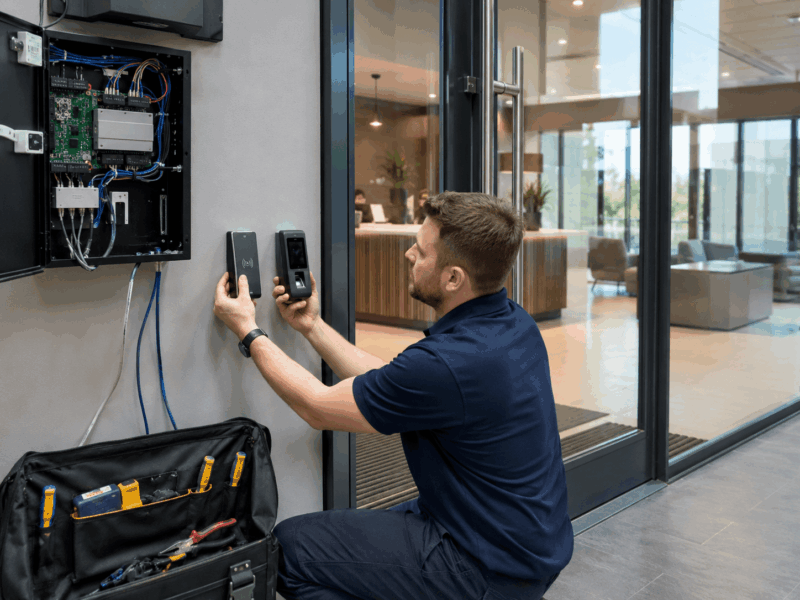
When RFID Readers Are the Better Practical Choice
RFID readers are often the better option when the client wants a reliable, scalable and cost-effective commercial access control system. They work well where many users need access and where visitor or contractor credentials change frequently.
For many projects, commercial RFID card readers provide the right balance between security and convenience. They are easy for users to understand and practical for installers to commission.
Common RFID-friendly sites include:
- Office entrances with staff and visitor access, where fast daily entry is important.
- Warehouses with shift workers who need simple and repeatable access.
- Commercial gates and car parks where drivers need quick vehicle entry.
- Multi-tenant properties where access permissions may change regularly.
- Sites where cards or fobs are already in use and the client wants consistency.
- Businesses that need simple credential replacement when staff leave, or cards are lost.
Commercial RFID card readers are often the practical default for commercial sites because they avoid the complexity of biometric enrolment and privacy discussions. They also allow the business to scale access control across more doors, gates and user groups.
Read more: Access Control For Gates & Doors: Keypads, RFID & App Control
When Biometric Readers May Be Worth Considering
Biometric readers may be worth considering when the site needs stronger proof that the authorised person is physically present. Unlike a card or fob, a biometric credential cannot be easily handed to another person. This can improve accountability in restricted areas where credential sharing is a known risk.
Good use cases include high-security internal rooms, sensitive stock areas, server rooms, laboratories, and management-only zones. These facilities require access logs that reflect the actual person entering the area. In these situations, biometric access can add an extra layer of control beyond standard card-based access.
Installers should assess the site conditions before recommending biometrics, including user volume, working environment, lighting, privacy expectations, hygiene concerns, maintenance capacity and backup access methods.

Common Installation Mistakes to Avoid
The reader type is only one part of a successful access control installation. Even good hardware can lead to callbacks and user frustration if it is installed without considering the way the site actually operates. Before recommending commercial RFID card readers or biometric readers, installers should look at the full access workflow.
Avoid these common mistakes:
- Choosing biometric readers for harsh outdoor locations without protection: Rain, glare, dust and temperature changes can affect performance, so outdoor biometric readers need careful placement and weather protection.
- Installing readers at the wrong height or angle: A reader may technically work, but if users cannot comfortably present their credentials, the entry experience will be poor.
- Forgetting accessibility requirements: Different users may have varying reach heights, mobility needs, or approach paths, especially at public-facing or workplace entrances.
- Assuming all readers integrate the same way: Reader interfaces, power requirements, software platforms and controller compatibility should be confirmed before installation.
- Underestimating biometric enrolment time: Enrolling users properly takes planning, especially on larger commercial sites with shift workers or multiple departments.
- Failing to discuss lost-card management: RFID systems are simple to use, but the client still needs a clear process for cancelling lost cards and issuing replacements.
- Using low-security credential technology where stronger credentials are required: Some sites may need higher-security cards, encrypted credentials or additional access layers.
- Not planning backup access methods: Power, network, reader, or controller failure should not leave the site without a practical way to manage entry.
- Ignoring future expansion: Extra doors, gates, lifts, tenant areas or car park entries may be added later, so the reader strategy should allow room to grow.
How Installers Should Recommend the Right Reader Type
The best reader recommendation starts with practical questions.
- What type of site is it?
- How many people need access each day?
- Are the users staff, visitors, contractors, tenants or delivery drivers?
- Is the entry point indoors, outdoors, sheltered or exposed?
- Does the client prioritise speed, cost, accountability, convenience or high security?
For many commercial sites, commercial RFID card readers offer the best balance of cost, reliability and user convenience. For higher-security areas, biometric readers may be useful as part of a layered access control strategy.
Installers should also think beyond the reader itself. Access control often needs to integrate with intercom systems, electric strikes, maglocks, automatic doors, sliding gates, swing gates, exit buttons, safety devices, and remote-release workflows. A good recommendation considers the full system, not just the device on the wall.
Read more: Choosing The Right Access Control System For Multi-Tenant Buildings
In Conclusion
Commercial RFID card readers and biometric readers both have a place in modern access control. RFID is usually the practical choice for commercial entrances that require reliable, scalable, and easy-to-manage access. Biometrics can be valuable when stronger personal accountability is required.
For installers, the right recommendation depends on site conditions, user behaviour, access volume, controller compatibility, commissioning workload, and long-term maintenance. The most advanced reader is not always the best reader if it creates daily frustration or unnecessary support calls.
DHS supports installers with access control hardware, RFID reader options, intercom integration, gate and door release solutions, and compatible automation products for commercial sites across Australia, New Zealand and the Pacific region. If you are specifying access control for a commercial door, gate, warehouse, office or restricted area, speak with us about choosing the right reader hardware and building a reliable system around it.
FAQs
Are commercial RFID card readers still secure?
Yes, commercial RFID card readers can be secure when the correct credential technology, controller, and access permissions are used. Security depends on the full system design, not just the reader.
Are biometric readers better than RFID readers?
Not always. Biometric readers can improve user accountability, but RFID readers are often easier to install, manage, and scale across commercial sites.
Can RFID and biometric readers be used on the same site?
Yes. Many sites use commercial RFID card readers for main entrances and biometric readers for higher-security internal areas.
Which reader type is easier to maintain?
RFID readers are generally easier to maintain because cards and fobs can be replaced quickly. Biometric readers may require sensor cleaning, enrolment updates, and more user support.
Are biometric readers suitable for outdoor gates?
They can be used outdoors only if the correct model, housing, lighting, and weather protection are planned. RFID is often more practical for exposed gate environments.