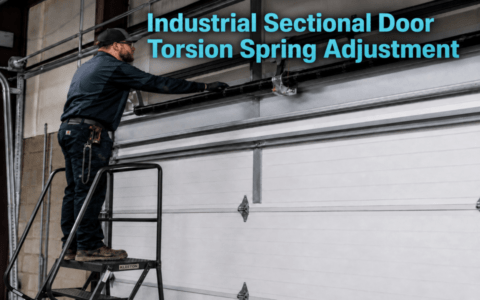
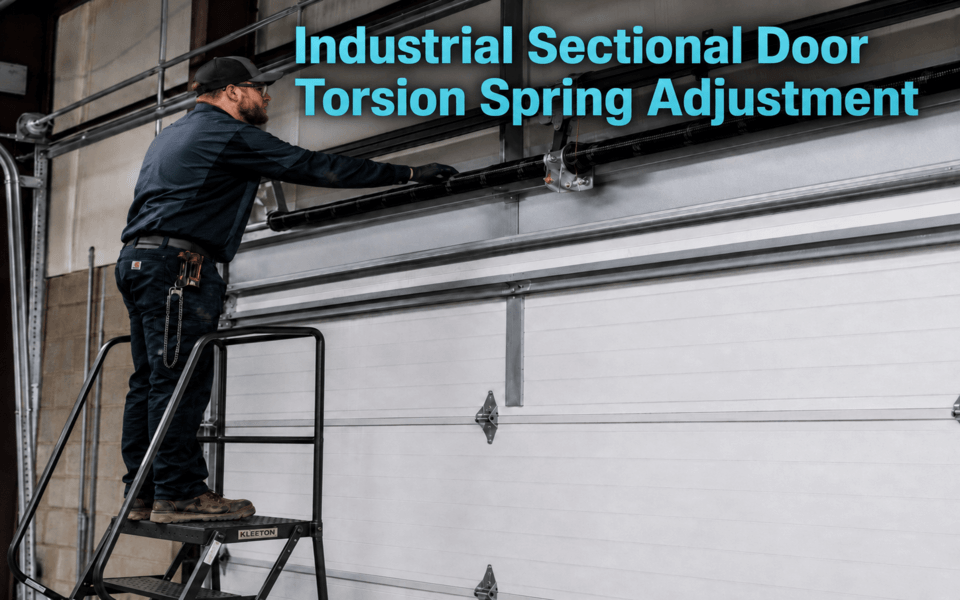
An industrial sectional door may weigh hundreds of kilograms, yet with the correct configuration, it can often be moved manually with controlled force. This is possible because the counterbalance system offsets much of the door’s weight as it travels through the tracks.
Torsion springs are central to this system, but their simple appearance can be misleading. A wound spring stores significant mechanical energy.
This article provides a safety-led technical overview for installers, explaining how to recognise possible balance problems, inspect the counterbalance assembly, make measured adjustments, and determine when existing springs should not be adjusted. Keep reading!
Understanding the Counterbalance System on an Industrial Sectional Door
The torsion springs are only one part of an interconnected mechanical assembly, and a fault elsewhere can create symptoms that appear to be a spring-tension problem.
Torsion springs are mounted around or beside a spring shaft, depending on the door configuration. When the springs are wound, they apply rotational torque to the shaft. Cable drums fixed to the shaft convert this torque into lifting force through the cables attached to the door’s bottom brackets.
As the industrial sectional door opens, the lifting cables wrap around the drums while the springs gradually unwind. As the door closes, the cables unwind from the drums and the springs regain tension.
Several components must work together correctly:
- Torsion springs store the mechanical energy required to counterbalance the door.
- The spring shaft transfers torque between the springs, drums and associated fittings.
- Cable drums control how lifting cables wind and unwind as the door travels.
- Lifting cables transfer force between the drums and the bottom of the door.
- Bottom brackets secure the lifting cables to the door and remain under substantial load.
- Bearings and bearing plates support the rotating shaft and maintain its alignment.
- Spring anchor brackets secure the stationary ends of the torsion springs.
- Tracks, rollers and hinges guide the door and influence its mechanical resistance.
- Shaft couplings connect shaft sections on wider or multi-spring industrial systems.
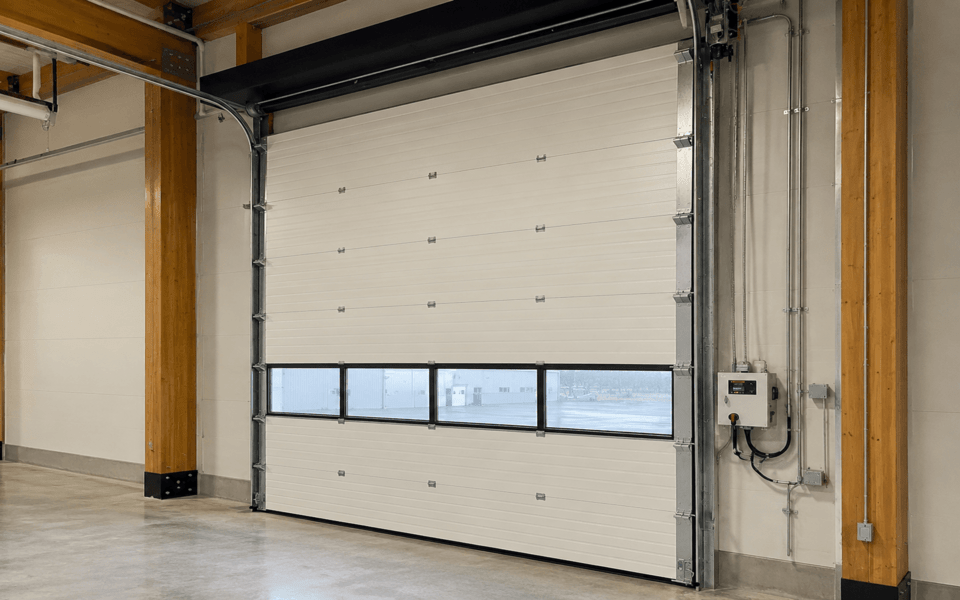
Industrial doors may use a single spring, dual springs or multiple coordinated springs. They may also have standard-lift, high-lift, vertical-lift, rear-mounted or low-headroom configurations. Each arrangement uses different spring directions, drum profiles, cable paths and adjustment procedures.
Warning Signs That Spring Tension May Need Assessment
Changes in manual movement can indicate that an industrial sectional door requires a professional counterbalance assessment. However, these symptoms do not automatically mean the springs need additional turns.
- The door feels unusually heavy when disconnected from the operator. Insufficient spring torque is one possibility, but the cause may also be a broken spring, a seized roller, a damaged bearing, a cable problem, a track obstruction, or additional door weight.
- The door rises from the floor without assistance. Excessive spring tension may pull the door upwards as soon as it is released. This can make the door difficult to control near the closed position and may create additional stress at the upper travel limit.
- The door will not remain near an intermediate height. A correctly balanced door should remain reasonably stable during a controlled manual balance test. Rapid rising or falling indicates that the counterbalance setting or mechanical condition requires investigation.
- One side rises faster than the other. Uneven cable tension, incorrect drum positioning, shaft movement, a damaged cable or distorted door hardware may cause the door to lift unevenly.
- The powered operator strains, stalls or reverses. Poor counterbalance may overload the operator, but installers must also inspect tracks, hinges, rollers, seals, panels, operator limits and force settings.
- Cables appear loose during travel. Loose cables may result from incorrect drum setup, cable-routing problems, shaft movement or loss of spring tension. Continuing to operate the door can allow a cable to leave its drum.
Adding tension without identifying the underlying cause can temporarily hide a mechanical fault. It may also transfer excessive force to the springs, shaft, drums, cables, operator or door structure.
Safe Procedure for Assessing and Adjusting Industrial Sectional Door Torsion Springs
The following sequence is intended only for trained industrial door technicians. Manufacturer instructions, site safety procedures and the specific door design always take priority over general guidance.
1. Secure the work area
Establish a clearly controlled exclusion zone around both sides of the opening. Prevent pedestrians, forklifts, vehicles, customers and other trades from approaching the door while the counterbalance system is being assessed.
Confirm that suitable access equipment is available. A stable elevated work platform may be required to provide secure access to the spring assembly. A ladder should not be treated as the default work position.
2. Isolate the powered operator
Switch off and isolate the electrical supply to the operator. Apply the site’s lockout/tagout procedure, then verify that the door cannot be activated from any connected control source.
Possible activation points include wall buttons, handheld transmitters, key switches, access-control relays, intercom systems, timers, vehicle detectors and building management systems.
Electrical isolation alone does not remove the mechanical hazards. The industrial sectional door still contains stored energy in its torsion springs and may move through gravity, spring torque or released mechanical restraints. These forces must be controlled separately.
3. Position and restrain the door
Many standard torsion assemblies are adjusted with the door fully closed. However, the required position depends on the lift arrangement, spring location and manufacturer’s design.
Confirm the specified adjustment position before proceeding. High-lift, vertical-lift, rear-mounted and low-headroom arrangements may require different methods.
Never rely solely on the operator gearbox, brake or drive chain to hold the door.
4. Inspect the counterbalance system
Complete a detailed visual and mechanical inspection before touching the winding system. Check for:
- Cracked, separated or heavily corroded springs
- Distorted or damaged winding cones
- Loose spring anchor brackets
- Worn bearings or displaced bearing plates
- Bent, scored or damaged shafts
- Loose or damaged shaft couplings
- Frayed, corroded or incorrectly routed lifting cables
- Cracked drums or damaged cable grooves
- Loose or distorted bottom brackets
- Bent tracks or damaged roller assemblies
- Missing or loose fasteners
- Evidence that the shaft has moved sideways
- Uneven cable seating or drum alignment
Adjustment must stop if any load-bearing component is damaged, incorrectly secured or unsuitable for continued service. Spring tension should never be used to compensate for structural misalignment, damaged cables or failing hardware.
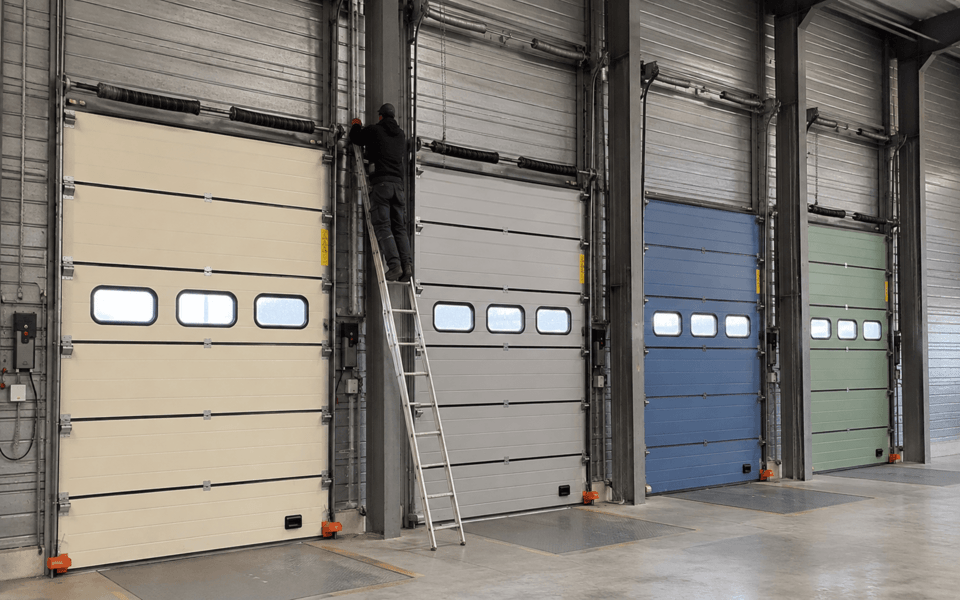
5. Confirm the tools and spring direction
Use properly sized, manufacturer-approved solid winding bars. The bars must fit the winding cone correctly and provide sufficient engagement to control the stored torque.
Screwdrivers, socket extensions, reinforcing bar, punches and other improvised tools must not be used. An incorrectly fitting tool can slip, bend or be ejected from the winding cone.
Identify whether each spring is left-wound or right-wound and confirm the required winding direction. Do not assume the direction based only on the spring’s position on the shaft.
Where appropriate, place reference marks on the shaft, spring, winding cone or cable drum. These marks can help the technician identify unexpected shaft movement and document the amount of adjustment.
6. Control the winding cone before loosening fasteners
Fully seat a winding bar in the cone before loosening any set screws. The technician must maintain a stable stance and keep their head and body outside the likely movement path of the bar.
The bar should be under positive control throughout the process. Loosening the cone without first controlling the spring torque can allow rapid rotation, tool ejection or uncontrolled shaft movement.
7. Make small and documented adjustments
Adjust the spring only in small, manufacturer-approved increments. Large changes make it difficult to identify the effect of each adjustment and increase the risk of over-tensioning the system.
On paired or multi-spring arrangements, maintain the specified relationship between the springs. Both sides must remain coordinated unless the manufacturer’s procedure states otherwise.
Record the relevant details during the work, including:
- Starting spring turns or reference position
- Number and direction of adjustments
- Shaft and drum positions
- Cable condition and seating
- Door behaviour after each balance test
- Any differences between paired springs
8. Tighten and verify the mechanical connections
After completing the adjustment, secure the winding cone fasteners according to the manufacturer’s procedure and specified torque.
Check that the shaft, keys, drums, couplings, bearings and cable attachment points remain correctly positioned. Confirm that both cables are seated in the drum grooves and that the shaft has not moved sideways during the adjustment.
Do not reconnect the powered operator at this stage. Manual balance testing must be completed first.
9. Remove restraints methodically
Remove winding tools, clamps and door restraints in a controlled sequence. Account for all tools before allowing the door to move.
Keep other personnel outside the exclusion zone and stand in a position that allows controlled manual movement without placing the body beneath the door or within a pinch point.
Testing Door Balance Before Reconnecting the Operator
Spring adjustment is incomplete until the industrial sectional door has been tested independently of the powered operator. Manual testing allows the technician to assess balance, resistance, cable tracking and overall mechanical condition without the operator masking the results.
Move the door cautiously and remain alert for sudden rising, dropping or uneven travel. A balanced door should move with controlled force, but acceptable behaviour varies with the door’s lift arrangement, seals, hardware and manufacturer specifications.
Use the following test sequence:
- Begin at the closed position. Lift the door slowly and check whether the initial force is controlled. Confirm that neither side pulls ahead.
- Pause near the quarter-open position. Observe whether the door rises, drops or remains reasonably stable.
- Repeat near the halfway position. This is often useful for evaluating overall balance, although the acceptable amount of movement depends on the door design.
- Test near the upper travel position. Confirm that both lifting cables remain seated on the drums and do not become loose.
- Cycle the door through its full travel. Listen and feel for bearing noise, roller binding, hinge resistance, panel contact, cable movement or track interference.
- Assess operating force as well as stationary balance. A door may remain in one position while still requiring excessive force because of damaged rollers, tight tracks, worn hinges or dragging seals.
Only reconnect and recommission the operator once manual movement is satisfactory. Check the travel limits, force settings, safety devices, emergency release and connected controls according to the manufacturer’s commissioning procedure.
In addition, the current Australian standard AS/NZS 60335.2.103:2024 addresses safety requirements for powered drives used with moving gates, doors and windows within its defined scope. Installers should confirm which standards, manufacturer requirements and workplace rules apply to the particular industrial installation.
When Not to Adjust Existing Industrial Sectional Door Springs
Spring adjustment is not always the correct repair. Certain conditions require the work to stop so that components can be replaced, recalculated or professionally assessed.
- The spring is cracked, separated or severely corroded. A failed spring cannot be restored by adding tension. Paired springs may need to be replaced as a matched set to maintain coordinated performance.
- A winding or stationary cone is damaged. Cracks, deformation, slipping fasteners or enlarged set-screw marks can prevent secure torque transfer between the spring and shaft.
- The lifting cables or drums are damaged. Spring adjustment cannot correct frayed cables, crushed drum grooves, incorrect cable lengths, cracked drums or unsuitable cable routing.
- The door weight has materially changed. New glazing, insulation, steel reinforcement, panels, locks or hardware may require a complete spring recalculation rather than a simple adjustment.
- The spring specification is unknown. Wire diameter, inside diameter, spring length, wind direction and cycle rating should be identified before deciding whether the spring remains suitable.
- The door is structurally misaligned. Bent tracks, damaged panels, displaced bearing plates or failing hinges must be repaired before balance can be assessed accurately.
- The spring is approaching the end of its service life. Repeatedly increasing tension on a fatigued spring may provide only temporary improvement while increasing the likelihood of failure.
Digital Home Systems can support installers, builders and commercial project teams with industrial door system assessment, automation specification, operator integration and project coordination. Where torsion spring replacement or structural door work falls outside the automation scope, DHS can assist in coordinating with suitably qualified industrial door specialists.
Final Thoughts
Adjusting the torsion springs on an industrial sectional door is a high-risk mechanical task. The technician must isolate the powered operator, mechanically restrain the door, inspect every load-bearing component and make only small, documented adjustments. Most importantly, poor door movement should never be treated as automatic evidence that more spring tension is required.
For support with industrial door automation, operator specification, safety integration or commercial access projects, contact us. DHS supplies and supports professional gate and door automation solutions and works with installers, builders and project teams to develop reliable, properly integrated solutions for demanding commercial environments.

Frequently Asked Questions
Can an industrial sectional door torsion spring be adjusted while the door is open?
The required position depends on the spring and lift arrangement. Many systems are adjusted with the door closed and mechanically restrained, but technicians must follow the specific manufacturer procedure.
How many turns should an industrial door torsion spring have?
There is no universal number. The correct setting depends on door height, mass, spring dimensions, drum type, lift configuration and the original spring calculation.
Why does an industrial sectional door drop when manually released?
Possible causes include insufficient spring torque, a broken spring, incorrect drum setup, cable movement or excessive mechanical resistance. The complete door system should be inspected before adjusting tension.
Should both torsion springs be adjusted equally?
Paired systems generally require coordinated adjustment. However, equal visible turns do not guarantee equal performance where spring specifications, fatigue, cables or shaft positions differ.
Can the door operator compensate for weak torsion springs?
No. Using operator force to move an incorrectly balanced door can overload the motor, gearbox, chain, belt and mounting hardware. The manual door must operate safely before recommissioning.
Read more: The Estimator’s Technical Guide to High-Speed Rapid Roll Doors for Logistics Facilities