In modern commercial alarm deployments, audible and visual alerting play a great role. On large commercial sites such as warehouses, logistics hubs, schools, healthcare facilities, and multi-building business parks, internal notification alone isn’t enough. Security events often occur at the perimeter, in car parks, loading docks, or external plant areas.
That’s where outdoor siren installation becomes critical. A properly positioned outdoor siren provides immediate deterrence and enables multi-zone signalling across expansive sites. Increasingly, commercial alarm designs are shifting from single centralised alarm outputs to distributed, wireless-triggered sirens, and they are positioned strategically around the property.
In this guide, we’ll walk through planning, compliance, positioning, integration strategies, and best practices for large-scale outdoor siren installation in commercial alarm environments.
Site Assessment Before Outdoor Siren Installation
Proper planning is what separates a reliable commercial alarm system from one plagued by false alarms, coverage gaps, or compliance issues. Before beginning any outdoor siren installation, a documented site survey should always be completed.
Below is a strategic technical checklist for large commercial sites:
Site Size & Acoustic Coverage
-
- Assess total land area and building footprint.
- Identify elevation differences between structures.
- Consider how hard surfaces (concrete walls, metal sheds) may reflect sound.
- Evaluate open spaces where sound may dissipate quickly.
- Map out potential acoustic shadow zones behind large structures.
Noise Environment
-
-
- Proximity to busy roads or highways.
- Continuous industrial machinery noise.
- Day vs night operational noise levels.
- Public-facing environments require noise sensitivity.
-
Risk Profile
-
- Perimeter vulnerability points (fencing gaps, rear access).
- High-value asset concentration zones.
- Public exposure areas where visible deterrence matters.
- Historical intrusion or vandalism data.
Mounting Locations
-
- Building façades facing primary access routes.
- Gate pillars at vehicle entry points.
- Loading dock areas.
- Rooftop mounting for broader sound dispersion.
- Mid-wall placement for improved strobe visibility.
- Avoidance of overhangs that block sound projection.
Power Availability
-
- Availability of hardwired supply.
- Suitability of battery-operated options.
- Backup power redundancy planning.
- Accessibility for maintenance.
Environmental Conditions
-
- Wind exposure corridors.
- Coastal corrosion risks.
- Direct sunlight heat exposure.
- Rainwater runoff paths.
- Dust-heavy industrial environments.
Every outdoor siren installation in a commercial alarm system should follow this documented site-survey process. It reduces risk, improves reliability, and ensures compliance from day one.
Acoustic & Visual Performance Requirements for Commercial Alarm Systems
Commercial outdoor sirens typically require a sound output of 110-120 dB to ensure adequate coverage in open areas. Anything lower may be ineffective in high-noise industrial environments or large warehouse perimeters.
However, decibel rating alone isn’t enough. Professional outdoor siren installation must consider:
- Sound dispersion patterns.
- Horizontal and vertical coverage angles.
- Avoiding “dead acoustic zones” behind structures.
- Minimising echo distortion in tight courtyards.
Equally important is visual alerting. A high-intensity strobe ensures the alarm condition is visible during daylight hours, not just audible. In large sites, especially those with heavy machinery or vehicle movement, visual cues can be as important as sound.
At night, glare management becomes critical. The strobe should be visible but not create hazardous glare for drivers or security patrols.
In multi-building deployments, synchronising multiple sirens ensures cohesive signalling across zones. Integrators must also program compliance features such as automatic alarm cut-off times to meet local council noise regulations.
Ultimately, effective outdoor siren installation balances performance with regulatory alignment.
Centralised vs Distributed Siren Architectures
When planning outdoor siren installation for a commercial alarm system, integrators generally work with one of two architectural approaches: a centralised output model or a distributed wireless model. Each has its place, but the demands of modern commercial sites are shifting the balance.
Centralised Output Model
The centralised model is the traditional approach. A single alarm panel controls one or more hardwired sirens, typically connected via dedicated output circuits. When the panel triggers, all connected sirens activate simultaneously.
This method offers simplicity. There’s straightforward wiring logic, predictable behaviour, and minimal configuration complexity. For small premises with limited perimeter exposure, it can be perfectly adequate.
However, there are limitations. A centralised design introduces a single point of failure; if the panel or output circuit fails, alerting capability is compromised. Cabling distances also restricts siren placement, particularly across large warehouses, campuses, or multi-building sites. Trenching and conduit runs can quickly increase labour and infrastructure costs.
Distributed Wireless Model
In contrast, a distributed wireless model uses multiple sirens positioned strategically across the site. These devices are triggered by smart sensors, zone controllers, or automation platforms rather than relying solely on a single output.
This enables:
- Zone-based activation
- Reduced wiring complexity
- Improved system redundancy
- Greater placement flexibility
Distributed models are becoming the standard for large commercial alarm deployments because they better align with modern security design. When integrated with access control, perimeter detection, and automation systems, they create layered escalation. For example, a gate breach detected via an automated entry system can trigger a localised siren response. Integrators designing perimeter automation often reference guidance such as this resource on Automatic Sliding Gate Motor Selection to ensure access infrastructure and alarm signalling operate cohesively.
For expansive sites, distributed outdoor siren installation delivers scalability, resilience, and smarter zone control, all essential for contemporary commercial environments.
Step-by-Step Outdoor Siren Installation Process
A structured approach to outdoor siren installation ensures consistency, compliance, and long-term reliability in commercial alarm deployments. Below is a practical procedural guide for large-scale sites.
Step 1: Pre-Installation Planning
-
- Confirm mounting height, typically between 2.5 and 4 metres above ground level, to deter tampering.
- Check clear line-of-sight to maximise strobe visibility from key approach points.
- Conduct RF signal testing if deploying wireless devices.
- Validate coverage zones against the site security plan.
- Confirm activation logic with the alarm programming strategy.
Step 2: Mounting Preparation
-
- Use corrosion-resistant fixings suitable for the environment (especially coastal or industrial sites).
- Ensure the wall substrate is solid and vibration-resistant.
- Avoid mounting onto thin cladding without reinforcement.
- Seal all penetrations to maintain weatherproof integrity.
- Confirm the siren housing sits flush to prevent water ingress.
Step 3: Power & Battery Setup
-
- Install backup batteries according to the manufacturer’s specifications.
- Double-check battery orientation before sealing the unit.
- Confirm the system recognises battery presence.
- Verify low-battery reporting functionality at the controller.
- Record battery installation date for maintenance scheduling.
Step 4: Network Pairing
-
- Include the siren in the alarm controller or automation hub.
- Confirm signal strength and mesh stability.
- Test triggering from multiple sensor types (motion, shock, door contacts).
- Validate zone-based activation if configured.
Step 5: Functional Testing
-
- Measure decibel output at reference distances.
- Verify strobe visibility during daylight conditions.
- Test tamper detection alerts.
- Confirm proper response during simulated alarm events.
Step 6: Compliance Check
-
- Program the automatic siren cut-off time to meet council requirements.
- Confirm alignment with regulatory noise limits.
- Document all commissioning results.
- Obtain client approval and sign-off.
Thorough documentation and commissioning are essential. Professional commercial alarm deployments rely on verified testing records, compliance confirmation, and clear maintenance planning to reduce liability and ensure dependable performance.
Integrating the VISION Z-Wave Outdoor Siren in Commercial Installations
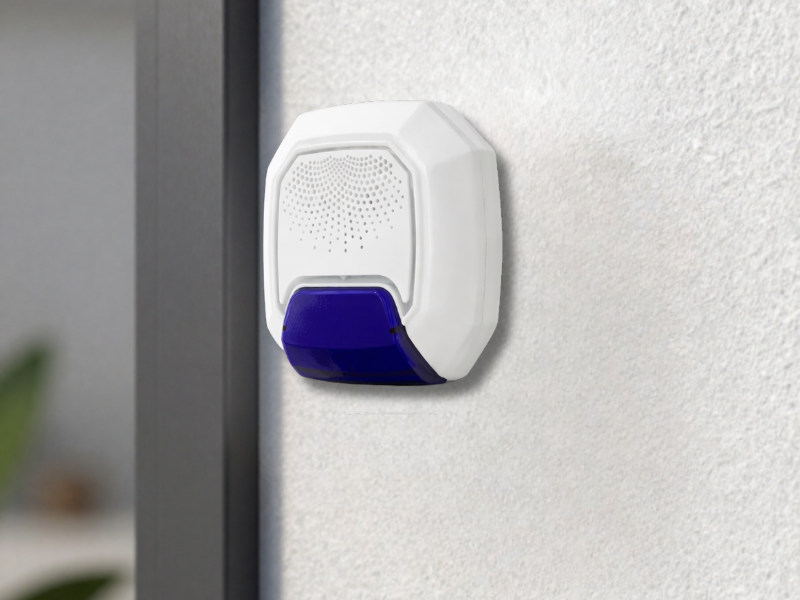
For wireless deployments, the VISION Z-Wave Outdoor Siren offers a practical and reliable solution for commercial alarm integrators.
Delivering a powerful 115 dB siren output with a bright blue flashing strobe, it provides strong audible and visual deterrence. As a Z-Wave Plus device, it integrates seamlessly into Australian-certified 921.42 MHz Z-Wave networks.
Key features include:
- 115 dB acoustic output.
- High-intensity blue strobe.
- Tamper detection.
- Low battery reporting.
- IP66 weather resistance.
- Approximate 2-year battery life (4 x D batteries included).
The siren integrates with leading controllers, including:
- Fibaro Home Center 3
- HomeSeer HS3
- Alarm.com security panels
This makes it ideal for warehouse perimeters, school grounds, business parks, and commercial strata complexes.
Because it is fully wireless, it is particularly well-suited to retrofit environments where trenching or additional cabling would be disruptive or cost-prohibitive. For distributed commercial alarm systems, it enables rapid expansion without compromising reliability.
Common Installation Mistakes to Avoid on Large Sites
Even experienced integrators can overlook small details that compromise performance. On large commercial alarm deployments, these mistakes can increase liability, reduce effectiveness, and create unnecessary call-outs.
Mounting too low
-
- Installing the siren within easy reach makes it vulnerable to tampering or physical damage.
- Outdoor units should be positioned high enough to deter interference while maintaining effective sound projection.
Installing directly under eaves
-
- Mounting under deep overhangs can muffle sound dispersion.
- Strobes may also lose visibility from key approach angles.
Ignoring RF signal mapping
-
- Wireless systems require proper signal testing.
- Failing to map coverage can lead to unreliable triggering or delayed activation.
Using non-weather-rated fixings
-
- Standard screws can corrode quickly in coastal or industrial environments.
- Compromised fixings may lead to water ingress or structural failure.
Failing to test strobe visibility in daylight
-
- A strobe that appears bright indoors may be ineffective in direct sunlight.
- Always confirm visibility from primary entry points.
Not enabling tamper alerts
-
- Tamper functionality is often available but left unconfigured.
- This reduces overall system integrity.
No battery maintenance schedule
-
- Battery-powered devices require documented maintenance intervals.
- Overlooked batteries can cause unexpected failures.
Professional outdoor siren installation minimises these risks, reduces false activations, and ensures commercial alarm systems operate reliably under real-world conditions.
Best Practices for Scalable Outdoor Siren Installation
Outdoor siren installation is not just a hardware task; it’s a strategic component of commercial alarm design. In large commercial environments, audible and visual signalling must align with risk profiles, zoning strategy, and compliance requirements.
Distributed architecture improves redundancy and zoning control, while environmental resilience ensures long-term reliability. Careful planning and proper commissioning are non-negotiable.
Solutions such as the VISION Z-Wave Outdoor Siren & Strobe provide integrators with flexible, wireless expansion options that support modern commercial alarm strategies.
For scalable deployments, technical guidance and product selection matter. Speak with DHS for an installation request, supply, system design advice, and professional support to ensure your next outdoor siren installation meets performance, compliance, and commercial expectations.