
Automatic sliding doors are now a core feature in modern commercial buildings, hospitals, airports, retail stores, and even high-end residential properties. Their smooth, hands-free operation improves accessibility, hygiene, and traffic flow while helping buildings maintain energy efficiency.
However, what most buyers see is only the glass panel moving quietly. Behind that motion is a sophisticated control logic system that determines:
-
When the door opens
-
How fast it moves
-
How safely it operates
-
When it closes
-
How it reacts to obstacles
If you are planning to purchase or specify an automatic sliding door, understanding the control logic is essential. It helps you avoid underperforming systems, safety risks, and unnecessary maintenance costs.
This in-depth buyer’s guide explains automatic sliding door control logic in clear, practical terms so you can make a confident buying decision.
What Is an Automatic Sliding Door?
An automatic sliding door is a powered door system that opens horizontally using a motorised operator controlled by sensors and a microprocessor controller. Instead of manual pushing or pulling, the system detects approaching users and activates automatically.
Where Automatic Sliding Doors Are Commonly Used
Automatic sliding doors are widely installed in:
- Shopping centres and supermarkets
- Hospitals and medical facilities
- Office buildings
- Airports and transport hubs
- Hotels and restaurants
- Cleanrooms and laboratories
- Modern residential homes
Their popularity comes from three major advantages:
- Hands-free convenience
- Improved accessibility compliance
- Better climate and energy control
Why Control Logic Matters in Automatic Sliding Doors
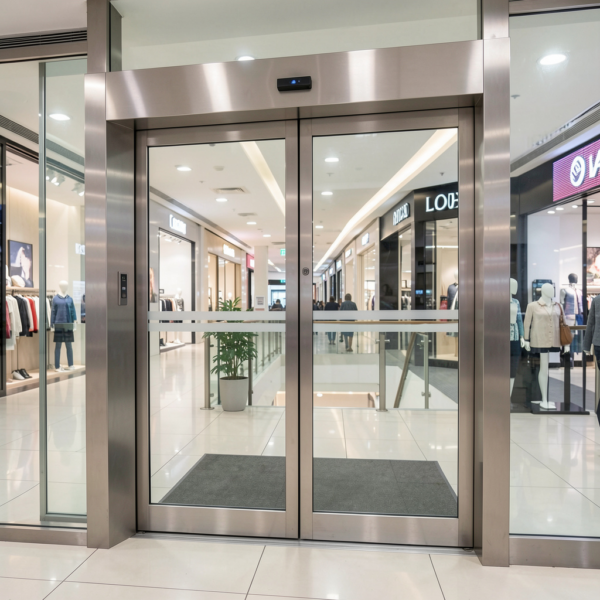
Many buyers focus on the motor power or door design. In reality, the control logic is the brain of the automatic sliding door system.
What the Control Logic Governs
The controller determines:
- When the door should open
- Opening and closing speeds
- Hold-open duration
- Safety responses
- Obstacle handling
- Emergency behaviour
- Energy-saving modes
Risks of Poor Control Logic
Inferior control systems often lead to:
- False triggering
- Unsafe closing behaviour
- Excessive energy loss
- Premature motor wear
- User frustration
Benefits of Advanced Control Logic
High-quality automatic sliding door logic delivers:
- Smooth pedestrian flow
- Maximum operational safety
- Reduced HVAC loss
- Quiet performance
- Longer equipment lifespan
- Core Components of Automatic Sliding Door Control
To understand the logic, buyers must first know the key hardware elements involved.
Motion Sensors
Motion sensors detect approaching pedestrians and initiate the opening cycle.
Common Sensor Types
- Microwave radar sensors
- Infrared motion sensors
- Dual-technology sensors
- Touchless activation sensors
For high-traffic environments, dual-technology sensors provide the most reliable detection.
Control Unit (Door Controller)
The controller is the central processing unit of the automatic sliding door.
Key Functions
- Processes sensor signals
- Controls motor speed and direction
- Manages safety inputs
- Executes opening and closing logic
- Stores operating parameters
- Reports faults and diagnostics
Modern controllers use microprocessor-based logic for precise operation.
Drive Motor
The motor physically moves the door panels via a belt or gear drive.
Typical Motor Options
- Brushless DC motors (industry standard)
- Brushed DC motors (older systems)
- AC motors (legacy installations)
Brushless DC motors are preferred because they offer:
- Quieter operation
- Higher efficiency
- Longer lifespan
- Better speed control
Safety Sensors
Safety sensors prevent the door from closing on people or objects.
Common Safety Devices
- Active infrared presence sensors
- Light curtains
- Safety beams
- Motor current monitoring
These components are essential for compliance with international safety standards.
Door Position Encoder
Encoders provide real-time feedback about the door’s position and speed.
Why Encoders Matter
They enable:
- Smooth acceleration and deceleration
- Precise stopping points
- Obstacle detection
- Soft open and close behaviour
Without encoder feedback, automatic sliding doors operate roughly and less safely.
Automatic Sliding Door Control Logic: Step-by-Step Operation
Understanding the operating sequence helps buyers evaluate system quality.
Detection Phase
When a person enters the detection zone, the motion sensor sends a signal to the controller.
Controller Decision Process
The controller first validates the signal to filter out false triggers such as:
- Moving shadows
- Rain or insects
- Reflections
- Environmental noise
If the signal is valid, the opening sequence begins.
Pre-Open Safety Check
Before the motor activates, the controller performs safety verification.
Typical Checks
- Safety sensors are functioning
- Door path is clear
- Motor is ready
- Door lock (if present) is disengaged
If any condition fails, the automatic sliding door will not move.
Soft-Start Opening
Modern systems use soft-start logic when opening.
What Happens During Soft Start
- Motor accelerates gradually
- Door begins moving smoothly
- Mechanical stress is reduced
- Noise is minimised
This feature significantly extends system life and improves user experience.
Full Open Hold Phase
When the door reaches the programmed open position, the controller starts a hold-open timer.
Typical Hold-Open Times
- Retail: 2–4 seconds
- Hospitals: 5–10 seconds
- Airports: 6–12 seconds
If motion continues to be detected, the timer resets automatically.
Closing Phase
Once the hold time expires and no presence is detected, the door begins closing using controlled deceleration.
Safety Monitoring During Closing
This is the most critical safety stage in automatic sliding door logic.
During closing, the controller continuously monitors:
- Presence sensors
- Light curtains
- Motor load
- Encoder feedback
If an Obstacle Is Detected
The door will:
- Stop immediately
- Reverse partially or fully
- Reopen and restart the timer
This behaviour is mandatory under most safety standards.
Fully Closed Confirmation
After reaching the closed position, the controller verifies:
- Door is fully seated
- Lock status (if equipped)
- System readiness
The automatic sliding door then returns to standby mode.

Advanced Control Logic Features Buyers Should Look For
Modern automatic sliding doors include intelligent features that significantly improve performance.
Intelligent Traffic Flow Logic
High-end controllers analyse traffic patterns and adjust behaviour automatically.
Capabilities May Include
- Adaptive hold-open timing
- Directional detection
- Peak-hour mode
- Energy-saving optimisation
This reduces unnecessary door cycles and improves efficiency.
Partial Opening Mode
The door opens only to a preset width when full opening is unnecessary.
Key Benefits
- Reduces air conditioning loss
- Speeds up cycle time
- Improves energy efficiency
- Ideal for low pedestrian flow
Buyers should look for programmable partial-open percentages.
One-Way Traffic Mode
Common in healthcare and secure facilities.
In this mode, the automatic sliding door only opens for traffic from one direction.
Typical Applications
- Infection control zones
- Security checkpoints
- Airport passenger flow
- Cleanroom environments
Night Mode / Locked Mode
In night mode:
- Motion sensors are disabled
- Door remains closed
- Access requires key switch or access control
This feature is essential for retail and commercial security.
Battery Backup Logic
During power failure, the controller executes emergency behaviour.
Possible Configurations
- Fail-safe open
- Fail-secure closed
- Controlled manual mode
Hospitals and emergency exits typically require fail-safe open operation.
Self-Diagnostics and Error Reporting
Premium automatic sliding door systems continuously monitor their own health.
Diagnostic Monitoring Includes
- Motor load trends
- Sensor status
- Cycle counts
- Encoder accuracy
- Temperature conditions
Faults may be displayed via LED codes, LCD screens, or building management systems.
Safety Standards Buyers Must Know
Compliance is critical when selecting an automatic sliding door.
Major International Standards
Common regulatory frameworks include:
- EN 16005 (Europe)
- AS 5007 (Australia)
- ANSI/BHMA A156.10 (United States)
These standards regulate:
- Opening and closing speeds
- Maximum closing force
- Sensor coverage
- Obstacle response time
- Emergency behaviour
Non-compliant doors can create serious legal and safety risks.
How to Choose the Right Automatic Sliding Door
Use this practical buyer checklist when comparing systems.
Assess Traffic Volume
Low traffic (residential or small office)
Choose a light-duty operator.
Medium traffic (retail environments)
Select commercial-grade equipment.
High traffic (airports and hospitals)
Use heavy-duty continuous-cycle systems.
Check Door Weight and Width
Heavier doors require:
- Higher torque motors
- Stronger rails
- More precise encoders
- Advanced control tuning
Always verify the manufacturer’s maximum door weight rating.
Evaluate Safety Sensor Quality
Never compromise on safety.
Look for systems that include:
- Active infrared presence detection
- Wide coverage fields
- Redundant safety protection
- Certified compliance
Review Control Adjustability
Quality automatic sliding door systems allow adjustment of:
- Opening speed
- Closing speed
- Hold-open time
- Partial opening width
- Sensor sensitivity
Avoid systems with limited programming flexibility.
Consider Noise Performance
Noise level is especially important in:
- Hospitals
- Offices
- Hotels
- Residential installations
Brushless DC operators with soft-start logic provide the quietest operation.
Look at Energy Efficiency
Energy-efficient automatic sliding doors should include:
- Partial opening capability
- Fast close timing
- Tight sealing
- Smart standby modes
These features significantly reduce HVAC losses.
Verify Integration Capability
Modern buildings often require door integration with:
- Access control systems
- Fire alarm systems
- Building management systems (BMS)
- Smart building platforms
Ensure the controller supports these interfaces.
Common Problems and How Good Control Logic Prevents Them
Understanding common failures helps buyers avoid poor systems.
Random Door Openings
Typical causes
- Low-quality sensors
- Poor signal filtering
- Incorrect sensitivity settings
Prevention
Choose automatic sliding doors with intelligent motion filtering.
Door Closes Too Fast
Typical causes
- Poor controller tuning
- No soft-close feature
- Limited programming
Prevention
Select systems with programmable speed curves.
Door Strikes Pedestrians
Typical causes
- Missing presence sensors
- Non-compliant systems
- Weak obstacle detection
Prevention
Ensure full safety sensor coverage and standards compliance.
Premature Motor Wear
Typical causes
- Hard start/stop motion
- No encoder feedback
- Undersized motor
Prevention
Choose brushless motors with soft-start logic and proper sizing.
Installation Factors That Affect Performance
Even the best automatic sliding door will perform poorly if installed incorrectly.
Critical Installation Points
Installers must ensure:
- Proper sensor alignment
- Correct door balancing
- Accurate encoder setup
- Level track installation
- Correct belt tension
- Stable power supply
Always use qualified automatic door technicians.
Maintenance Requirements Buyers Should Expect
Automatic sliding doors require routine servicing to maintain safety and reliability.
Recommended Maintenance Schedule
Monthly
- Visual inspection
- Sensor cleaning
- Track cleaning
Quarterly
- Safety testing
- Speed verification
- Belt inspection
Annually
- Full system service
- Encoder calibration
- Motor inspection
- Compliance verification
Systems with built-in diagnostics simplify maintenance significantly.
Future Trends in Automatic Sliding Door Control
The automatic sliding door industry is evolving rapidly.
AI-Based Traffic Prediction
Controllers will increasingly learn pedestrian patterns and optimise door behaviour automatically.
Enhanced Touchless Hygiene Modes
Demand for completely touch-free entry continues to grow in healthcare and retail.
IoT and Remote Monitoring
Future systems will support:
- Cloud diagnostics
- Predictive maintenance
- Remote firmware updates
- Usage analytics
Smart Building Integration
Automatic sliding doors are becoming fully integrated components of intelligent building ecosystems.
Final Buyer Checklist
Before purchasing an automatic sliding door, confirm the system:
- Complies with relevant safety standards
- Uses a brushless DC motor
- Includes full presence detection
- Offers programmable control logic
- Supports partial opening
- Provides battery backup
- Includes diagnostic capability
- Is installed by certified professionals
Conclusion
An automatic sliding door is far more than a moving glass panel. It is an intelligent access system driven by sophisticated control logic that governs safety, performance, and efficiency.
Buyers who understand how detection, motor control, and safety monitoring work together are far better positioned to choose reliable, compliant systems that deliver long-term value.
When comparing options, always look beyond the hardware. The true difference between average and exceptional performance lies in the quality of the control logic.