

Outdoor warning devices for commercial sites are frontline deterrents designed to prevent incidents from escalating. In today’s environment, where warehouses, offices, and industrial facilities face increasing risks from intrusion, having a visible and audible alert system is essential.
A well-placed commercial outdoor siren or flashing strobe sends an immediate message: this site is protected. And effectiveness comes from thoughtful planning. This is where a detailed security site survey becomes critical. Every site is different, and factors such as layout, access points, and environmental conditions influence how outdoor warning devices for commercial sites should be deployed. In this guide, we’ll walk through exactly what to assess to ensure your system delivers maximum impact.
What Are Outdoor Warning Devices and Why They’re Essential
Outdoor warning devices for commercial sites typically include sirens, flashing strobes, or combined units that provide both audible and visual alerts. These devices are designed to activate when a security event occurs. They could be an intrusion, unauthorised access, or environmental hazard.
The audible component grabs immediate attention. Whether it’s staff on-site, nearby security personnel, or even passers-by, the sound signals that something is wrong. The visual component, often a bright strobe light, reinforces this alert in noisy environments or low-visibility conditions.
Importantly, these devices don’t operate in isolation. They form part of a broader security ecosystem that may include alarm panels, motion detectors, door and window sensors, and smart automation platforms. Technologies like Z-Wave or KNX allow seamless communication between devices, ensuring that alerts are triggered instantly and appropriately.
For commercial environments, the benefits are clear:
- Immediate deterrence that can prevent incidents from escalating
- Faster awareness of breaches or emergencies
- Improved coordination between security systems and personnel
However, to unlock these benefits, outdoor warning devices for commercial sites must be planned properly. That begins with a thorough site survey.

Mapping Your Site: Layout and Risk Assessment Essentials
Before selecting or installing any outdoor warning devices for commercial sites, a comprehensive understanding of the site is essential. This involves evaluating both physical layout and potential risks.
- Site size and perimeter complexity
Larger commercial properties often require multiple devices to ensure full coverage. A single siren may not reach all corners of a warehouse or industrial yard. Irregular layouts, such as sites with multiple buildings, split zones, or obstructed sightlines, demand a more strategic approach. Blind spots, narrow corridors, and enclosed loading areas can all reduce the effectiveness of poorly planned installations.
- Access points and traffic flow
Every entry and exit point should be clearly identified, including gates, roller doors, staff entrances, and loading docks. High-traffic areas, where people or vehicles frequently move, often benefit from more prominent warning devices. These locations not only require effective alerting but also serve as visible deterrents to anyone approaching the site.
- Risk zones and vulnerability mapping
Not all areas carry the same level of risk. Storage zones with high-value goods, isolated corners, and poorly lit areas are more vulnerable to intrusion. Rear access points or service entries are also common weak spots. External warning devices for commercial sites should be positioned to prioritise these higher-risk zones.
- Neighbouring properties and environment
The surrounding environment matters. Sites near residential areas may need to consider noise sensitivity and local expectations, while industrial zones typically allow higher decibel levels. Understanding this context helps balance effective deterrence with compliance.
- Existing security infrastructure
A site survey should also assess what’s already in place – CCTV cameras, lighting, fencing, and access control systems. Outdoor warning devices should enhance these systems, not duplicate them. For example, placing a siren within a well-covered CCTV zone can improve incident verification and response.
Smart Placement: Maximising Coverage, Visibility, and Deterrence
Once the site assessment is complete, the next step is to determine where and how to install outdoor warning devices for commercial sites to maximise effectiveness.
- Audible coverage planning
The primary goal is to ensure the siren can be heard across all critical areas. This means accounting for obstacles such as walls, machinery, storage racks, or shipping containers that may block or absorb sound. In large or segmented environments, multiple devices may be required to achieve consistent coverage.
- Visual line-of-sight for strobes
Flashing strobes are most effective when they are clearly visible from multiple angles. Devices should be positioned to maximise line of sight across open areas and key approach paths. Elevation plays a crucial role here: higher mounting positions allow the strobe to be seen over obstacles.
- Height and mounting considerations
Devices should be installed high enough to deter tampering or vandalism, but not so high that maintenance becomes impractical. A balanced approach ensures both security and serviceability. Mounting on exterior walls, poles, or building corners is common practice.
- Entry-point prioritisation
Placing outdoor warning devices near main access points reinforces the perception of a secure site. When potential intruders see and hear a device near an entry, it signals active monitoring and increases the likelihood they’ll abandon their attempt.
- Redundancy and overlap
Relying on a single device creates a single point of failure. Overlapping coverage ensures that even if one device is obstructed or compromised, another can still deliver the alert. This redundancy is especially important for high-risk or high-value sites.

Environmental and Compliance Factors You Can’t Ignore
Outdoor warning devices for commercial sites must be built and specified to handle real-world conditions. Environmental exposure is one of the biggest challenges, particularly in regions with harsh weather.
Rain, dust, extreme heat, and humidity can all impact performance over time. That’s why devices with strong ingress protection ratings, such as IP66, are essential for outdoor installations. These ratings indicate resistance to dust and water, ensuring long-term durability.
Noise regulations are another key consideration. Many local councils impose limits on siren volume or duration, especially in areas close to residential zones. Choosing devices with configurable settings allows installers to meet compliance requirements while still maintaining effective deterrence.
Power and reliability also play a role. Battery-powered devices offer flexibility and are ideal for retrofits or locations without easy access to wiring. However, backup power options and low-battery alerts are important to ensure continuous operation.
Connecting the System: Integration With Sensors and Automation
Outdoor warning devices for commercial sites deliver the best results when they’re part of an integrated system rather than standalone components. By connecting them with sensors and automation platforms, you create a smarter, more responsive security setup.
- Intrusion detection sensors: Motion sensors, door and window sensors, and perimeter detectors can trigger outdoor sirens instantly when unauthorised activity is detected. This immediate response is critical for deterrence.
- Specialised sensors: Beyond intrusion detection, devices such as flood sensors, shock sensors, and vibration detectors expand the system’s capabilities. For example, a shock sensor on a fence or wall can trigger an alert before a breach fully occurs.
- Automation platforms: Systems based on Z-Wave, KNX, or hybrid platforms allow for custom automation rules. These platforms enable outdoor warning devices at commercial sites to respond intelligently to specific triggers or conditions.
- Zoning and conditional alerts: Different areas of a site can be assigned unique rules. For instance, a rear storage area might trigger a full siren and strobe, while a staff entrance may use a softer alert during business hours. This reduces false alarms and improves relevance.
- Remote monitoring and control: Integration also enables remote access. Facility managers can receive alerts on their devices, monitor system status, and even trigger alarms manually in emergency or panic situations.
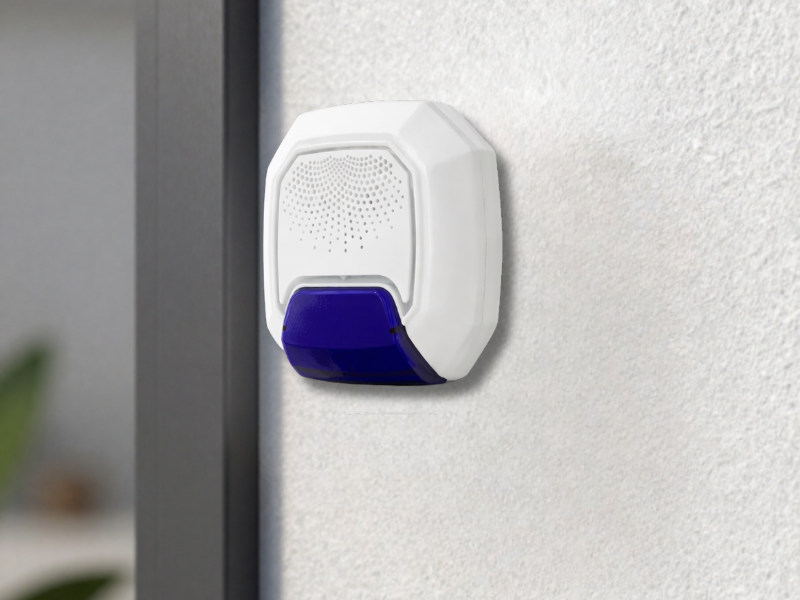
Choosing the Right Outdoor Warning Devices for Commercial Sites: Key Features That Matter
Selecting the right outdoor warning devices for commercial sites involves more than just picking a siren. The following features are critical for performance and reliability:
- Sound output (decibel level): Commercial environments typically require high-output sirens – often 100 dB or more – to ensure alerts are heard across large or noisy areas.
- Visual alert strength: Bright, high-intensity strobes are essential for visibility in both daylight and nighttime conditions, especially in busy or industrial settings.
- Wireless vs wired capability: Wireless solutions, such as Z-Wave-based devices, simplify installation and are ideal for retrofits. They reduce the need for extensive cabling while maintaining reliable communication.
- Battery life and maintenance: Long battery life minimises maintenance requirements. Devices with multi-year battery performance are particularly valuable for large or multi-site deployments.
- Tamper detection: Built-in tamper alerts notify the system if a device is removed or interfered with, adding an extra layer of security.
- Compatibility with controllers: Ensuring compatibility with existing or planned systems is essential. This includes integration with alarm panels, automation platforms, and monitoring solutions.
- Ease of installation: For installers and integrators, quick and straightforward setup is a major advantage, especially when deploying multiple units across a large site.
- Durability rating: Outdoor warning devices for commercial sites must withstand the elements. High IP ratings and robust construction ensure long-term performance.
From Site Survey to Stronger Security Outcomes
Outdoor warning devices for commercial sites are only as effective as the planning behind them. A thorough site survey lays the foundation for success, ensuring that every device is positioned, configured, and integrated for maximum impact.
By carefully assessing site layout, identifying risk zones, and considering environmental and compliance factors, you can design a system that delivers both strong deterrence and reliable performance. Placement strategy, sensor integration, and feature selection all play a role in achieving this outcome.
Solutions like the Vision Z-Wave Outdoor Siren demonstrate how modern devices meet commercial requirements. With a powerful 115 dB siren, bright flashing strobe, wireless Z-Wave compatibility, and an IP66-rated design, it offers a flexible and durable option for a wide range of sites. Its battery-powered operation, long lifespan, and tamper alerts further enhance its practicality.
As commercial security continues to evolve, outdoor warning devices for commercial sites will remain a key component of layered defence strategies, helping businesses stay protected, responsive, and one step ahead.